

Server rail kit price is one of the least transparent numbers in rack hardware. The same 2U server can be mounted on a fixed support rail, a friction slide or a tool-less ball-bearing kit with a cable management arm, and those are different products at different cost levels. This guide explains the tiers, what adds cost inside each tier, how OEM-branded, generic and custom kits differ, and what to send in an RFQ if you want a real price rather than a placeholder.
Cost tiers by rail type
Rail kits sort into five tiers by mechanism. Each tier adds parts, precision or both, and the price follows. The order below is stable across suppliers even when the absolute numbers are not.
- Fixed and support rails. Two L-shaped or C-shaped members that carry the chassis but do not slide. A simple support structure with no sliding mechanism; compare the specified fit and total project cost. Suitable for equipment that is serviced from the front or pulled out of the rack entirely. See fixed rack rails.
- Friction sliding rails. An inner member slides inside an outer member on formed contact surfaces, with no bearings. More steel and a slot, but still simple. Good for lighter chassis and occasional access; ball-bearing vs friction rails explains the trade-off.
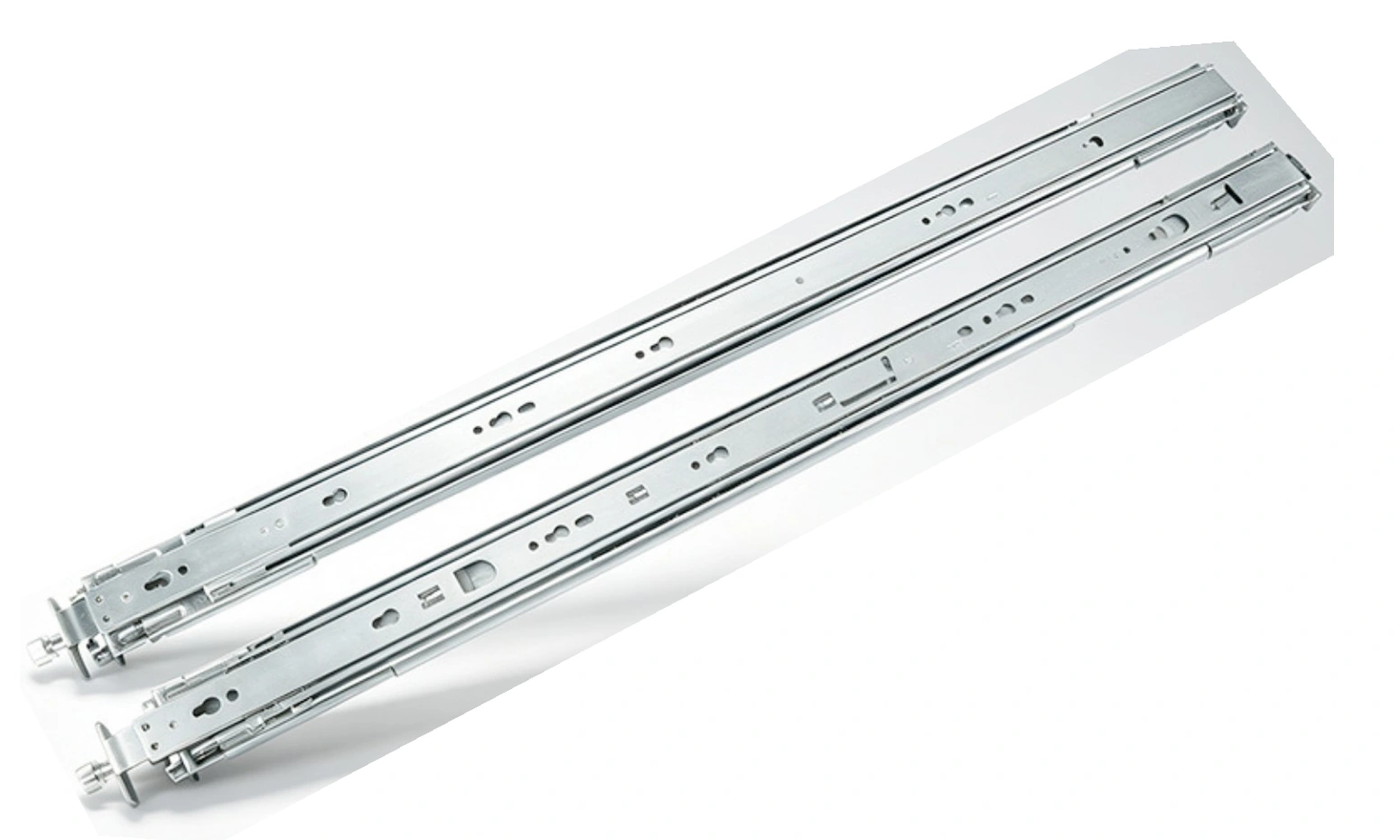
- Ball-bearing sliding rails. Bearing retainers between members, ground raceways and a smoother, higher-load slide. More parts, tighter tolerances, higher cost. This is the default for hot-swap and top-access servers.
- Tool-less ball-bearing rails with lock-out. Adds spring latches for square-hole racks, lock-out at full extension, lock-in at the rear and a release lever on the inner member. The most parts and the most assembly; the standard for volume data center deployment, as covered in hyperscale data centers and the rise of tool-less rails.
- Heavy-duty rails at 150 kg and above. Thicker strip, more bearing rows, longer overlap and often a wider section, for GPU, AI and liquid-cooled servers. Top of the range in cost, and increasingly the tier that matters; see heavy-duty rails for GPU and AI servers.
The types of server rack rails guide covers the mechanics behind each tier if you are still deciding which one you need.
What adds cost inside a tier
Two ball-bearing kits can differ by a wide margin. The usual reasons:
- Length. A rail is priced partly by the steel in it. Longer members for deep racks cost more, need longer boxes and ship at higher freight. Specify the rack depth range you actually have, using the rack mounting depth guide.
- Material thickness. Thicker cold-rolled strip raises load rating and cost together. Ask for the thickness rather than assuming from the load figure.
- Finish. Zinc plating is the common finish; the plating type, thickness and any salt spray requirement all move the price. A basic clear zinc and a heavier corrosion-resistant finish are not the same line item.
- Cable management arm. A CMA is a separate assembly with its own brackets. Bundled, it raises the kit price; optional, it lets you decide per rack.
- Packaging. Pair-per-box with bagged hardware protects the rails and costs more than bulk cartons. For a data center rollout, bulk can make sense; for resale, individual boxes usually do.
- Certifications and testing. A supplier's ISO 9001 and ISO 14001 registration, load testing and cycle testing are part of what you pay for. Ask what tests back the load rating; server rail load capacity explained covers static versus dynamic figures.
OEM-branded vs generic vs custom
The same tier can be bought three ways, and the price logic differs for each.
OEM-branded kits. The rail kit sold by a server vendor under its own part number, such as Dell ReadyRails or HPE rail kits. The vendor sets the price, the kit fits one server family, and availability follows the server's lifecycle. You pay for exact fit and vendor support, and you cannot change anything.
Generic and universal kits. Catalog rails from rail makers and distributors, sized by U height and rack depth range rather than by server model. Cheaper per kit at the low end, usually in stock, but fit is approximate, and load ratings on adjustable kits tend to be lower. The universal server rails category is an example of this class.
Custom and functional-equivalent kits. Rails engineered to a specific chassis from its drawing, either to replace a discontinued OEM kit or to fit a chassis that never had one. The unit price sits near the generic tier for the same mechanism, but there can be one-off engineering and tooling cost, which the next sections cover. The difference between a functional equivalent and a copy is explained in replacement server rails: functional equivalent vs copy.
Marketplace reference points
Public prices for rail kits are rare, and most of what you find is retail resale. Two observations from US marketplaces, as of September 2026, are worth citing because they are typical of what a single-pair buyer sees:
- Chenbro 84H341300-002, a King Slide-made 26-inch 2U to 4U sliding rail kit sold at retail, was listed at roughly US$50 to US$66 on Walmart, Amazon and smaller e-tailers.
- Dell ReadyRails II 2U sliding rail kits (type B6) appeared in used and refurbished listings at roughly US$80 to US$120 on eBay and refurbisher stores. New kits from the server vendor cost more; check the vendor store for the current figure.
These are listings, not official prices, and they describe two specific kits. They are useful as a sanity check on a quote for a similar 2U sliding kit at single-pair quantity, and useless for anything else: a heavy-duty GPU rail, a 1,000-pair order or a custom bracket will not land in those ranges.
Volume and MOQ effects
Rail pricing is batch-driven. Setup on the stamping line, inspection and packing are largely per batch, so the per-pair figure falls as the batch grows and flattens after a few hundred pairs on a standard model. Three things to check:
- MOQ. Some suppliers set a minimum order for any model; others sell standard models from a single pair and reserve MOQs for custom work. Ask before assuming.
- Price breaks. Request the unit price at sample quantity, at your first order and at annual volume. A single figure hides where the breaks are.
- Program pricing. Tier-1 slide makers sell through OEM programs with a forecast volume attached. According to King Slide's website, for example, there is no server-rail catalog or price list, and the only path is an enquiry form. That model works at server-brand scale and rarely for a buyer with a few hundred chassis. Our wholesale vs OEM rails post looks at when private labeling and program-style buying pay off.
Hidden costs that do not appear on the quote
The cheapest quote is often not the cheapest kit once it reaches the rack.
- Wrong fit. A rail that does not engage the chassis standoffs, or that fouls the rack post, costs the kit price plus the return freight plus the time. This is the most common hidden cost on universal and marketplace kits. The server rail compatibility checklist catches most of it before you order.
- Rework. Drilling brackets, adding adapters or shimming rails in the field. It works once and is unrepeatable at scale.
- Freight. Rails are long, heavy and easy to dent. Air freight on a sample is reasonable; air freight on volume is not. Ask for a landed price with the Incoterm stated.
- Tooling and NRE. On custom kits, a new die or bracket tool is a one-off charge. Some changes, such as hole patterns, length, thickness and bracket adjustments, can be absorbed by a supplier with its own tooling workshop; a new rail section cannot. Custom server rail cost and NRE separates the two.
- Sample cycles. Every sample round costs a pair and a shipment. Getting the drawing right the first time is the cheapest engineering you will do.
What to put in an RFQ to get a real price
A rail supplier can only price what is specified. Send the following, and you will get a number you can compare instead of a range with caveats.
- Chassis drawing or the measurements from the compatibility checklist: depth, height in U, side profile, standoff or hole pattern.
- Loaded chassis weight, static and dynamic.
- Rack type and hole type: square, round or threaded, per rack hole types.
- Rack depth range, front post to rear post.
- Rail type and functions: fixed, friction, ball-bearing, tool-less, lock-out, lock-in, release.
- Travel required, partial or full extension.
- CMA required or not.
- Finish and any corrosion requirement.
- Packaging: pair per box or bulk, hardware bagged or loose.
- Quantities: sample, first order, annual volume.
- Delivery terms and destination.
The full template, with the file formats that make an engineer's review faster, is in server rail RFQ: what to send, and the quote page accepts drawings directly.
FAQ
How much does a server rail kit cost?
There is no single answer, because fixed, friction, ball-bearing, tool-less and heavy-duty kits are different products. As a public reference, a King Slide-made Chenbro 84H341300-002 2U to 4U sliding kit was listed at roughly US$50 to US$66 on US marketplaces as of September 2026, and used Dell ReadyRails II 2U kits at roughly US$80 to US$120 on eBay and refurbisher stores; new vendor kits cost more.
Why are tool-less rails more expensive than screw-mount rails?
Tool-less kits add stamped latches, springs, pins and a release mechanism, plus the assembly of those parts. They save installation time on every server, which is why volume deployments accept the higher kit price. See tool-less vs screw-mount rails.
Are generic rails cheaper than OEM-branded rails?
Usually, at the kit level, but generic rails fit approximately and often carry a lower load rating. Wrong fit, rework and returns can erase the difference on a chassis with factory standoffs.
Does a custom rail kit always carry a tooling charge?
No. Changes within a supplier's existing tooling boundaries, such as hole patterns, length, thickness and bracket changes, can be handled without a tooling fee by a manufacturer with an in-house tooling workshop. A new rail section usually does carry one.
What is the fastest way to get an accurate rail price?
Send a complete RFQ with the chassis drawing, weight, rack type, rail functions and quantities. Suppliers price what they can see; missing data produces a wide range and a slow reply.
Next step
Put the RFQ list above into one message and send it through the quote page. MetrixSlide prices factory-direct per project, quotes within one business day, charges no tooling fee on flexible changes, and sells sample pairs on standard models so you can check fit in your own rack before volume. To see the standard sliding range first, start at sliding rack rails.
King Slide is a trademark of King Slide Works Co., Ltd. Dell and PowerEdge are trademarks of Dell Inc. HPE and ProLiant are trademarks of Hewlett Packard Enterprise. Other brand names are the property of their respective owners and are used only to describe compatibility or comparison. MetrixSlide is not affiliated with, endorsed by, or sponsored by these companies.