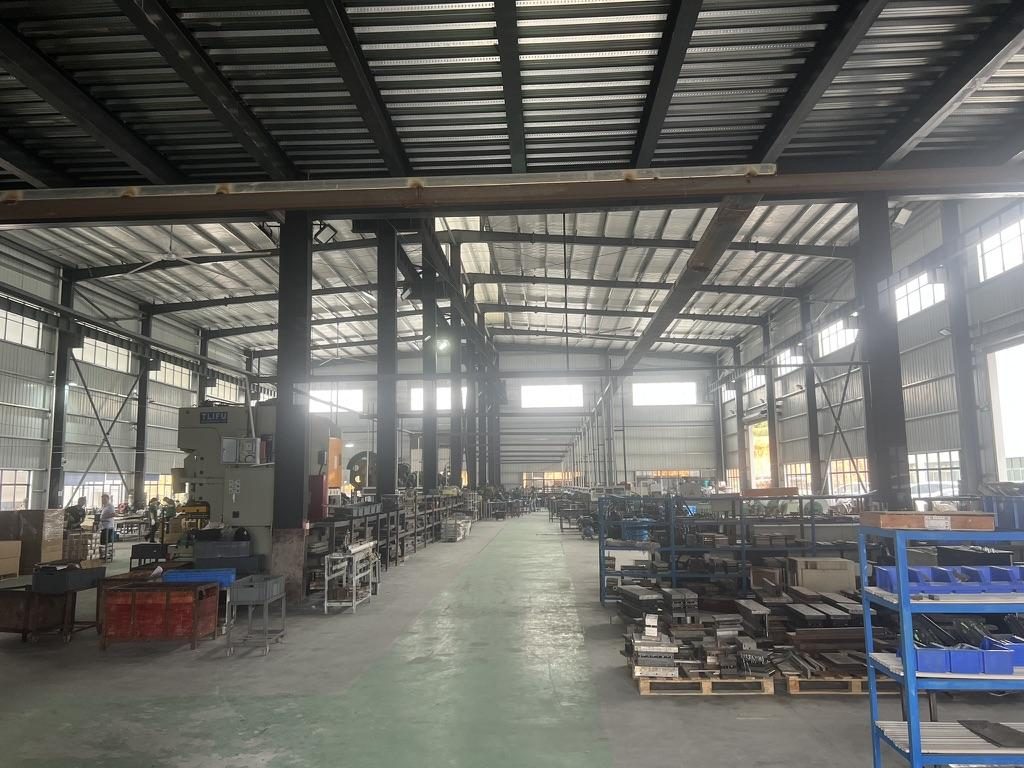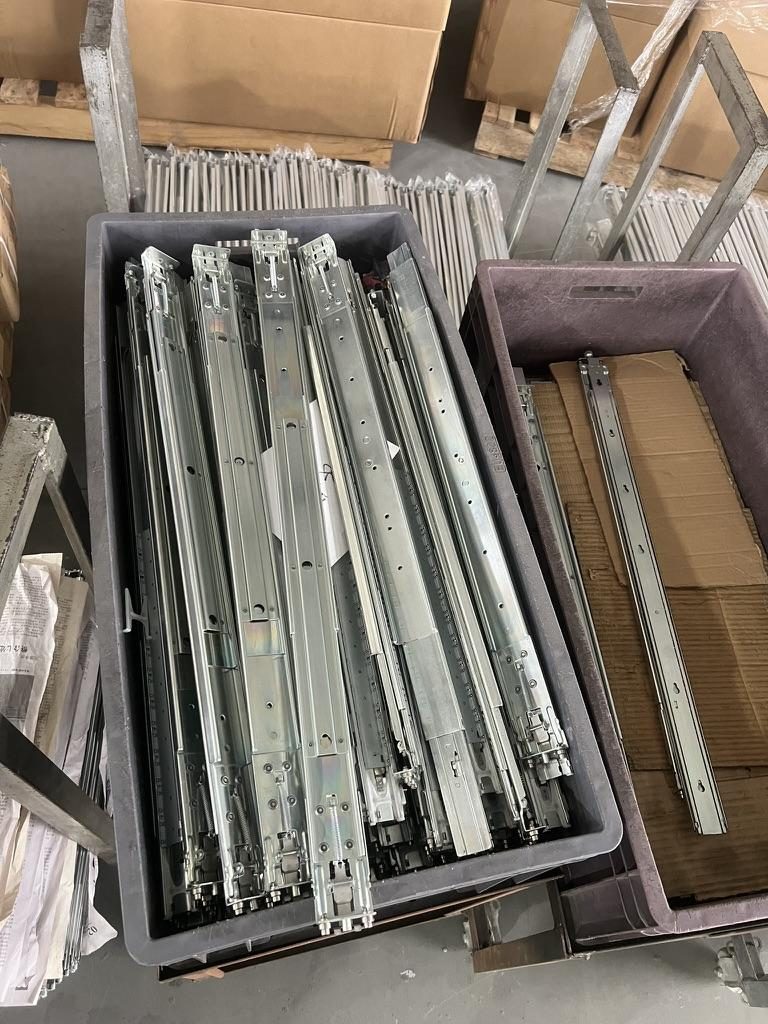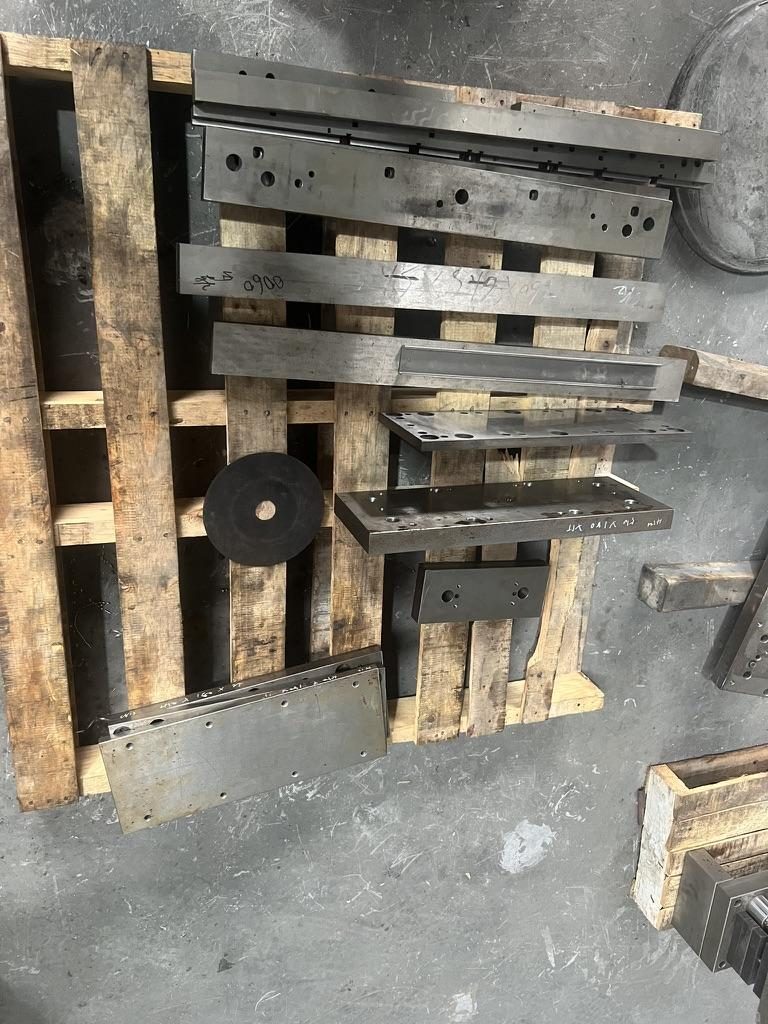

Where stock SKUs stop being cheap enough, where bounded customization starts to be effectively free, and where a full private-label rail program finally earns its tooling.
Wholesale server rails vs OEM private label is a purchasing decision, not a technical one — but it is decided by technical facts. Stock rails are cheapest per unit and fit the largest number of racks; private-label rails carry your branding, your packaging and your chassis interface, and they cost more per unit until volume dilutes the one-time engineering behind them. This guide maps the crossover points, and the fit checks that decide whether either path works at all.
Cost Comparison: Wholesale Rails vs OEM/Private-Label
Wholesale rails and OEM rails are priced from different cost stacks. Knowing which line items apply to your order is what makes the comparison honest.
What is actually in the price
- Unit price of the rail. Hardware, sliding mechanism, brackets, fasteners and finishing.
- One-time engineering. NRE and tooling appear only when the project needs a structural change or a 1:1 copy of an existing rail. Bracket position, hole pattern, rail length and rail thickness are bounded customization — they are adjusted on existing platforms and normally carry no tooling fee.
- Samples and pilots. Pilot quantities in the low tens of pairs are a normal way to de-risk before committing to a volume ladder, and sample cost should be discussed as a credit toward production.
- Packaging and print (private label only). Artwork, printed cartons, labels and print minimums are one-time or minimum-order costs.
- Landed cost. Freight, duty, customs clearance, inland drayage and warehousing. An FOB unit price and a DDP unit price are not the same number, and neither one is your landed cost.
MOQ and discount tiers. MOQ is a commercial variable, not a specification. It moves with material run length, finishing batch size and packing format, so two suppliers can quote the same rail with very different minimums. Ask for the quantity ladder in writing, and ask whether the quote assumes a dedicated production run or a shared batch — that is where tiered pricing usually comes from.
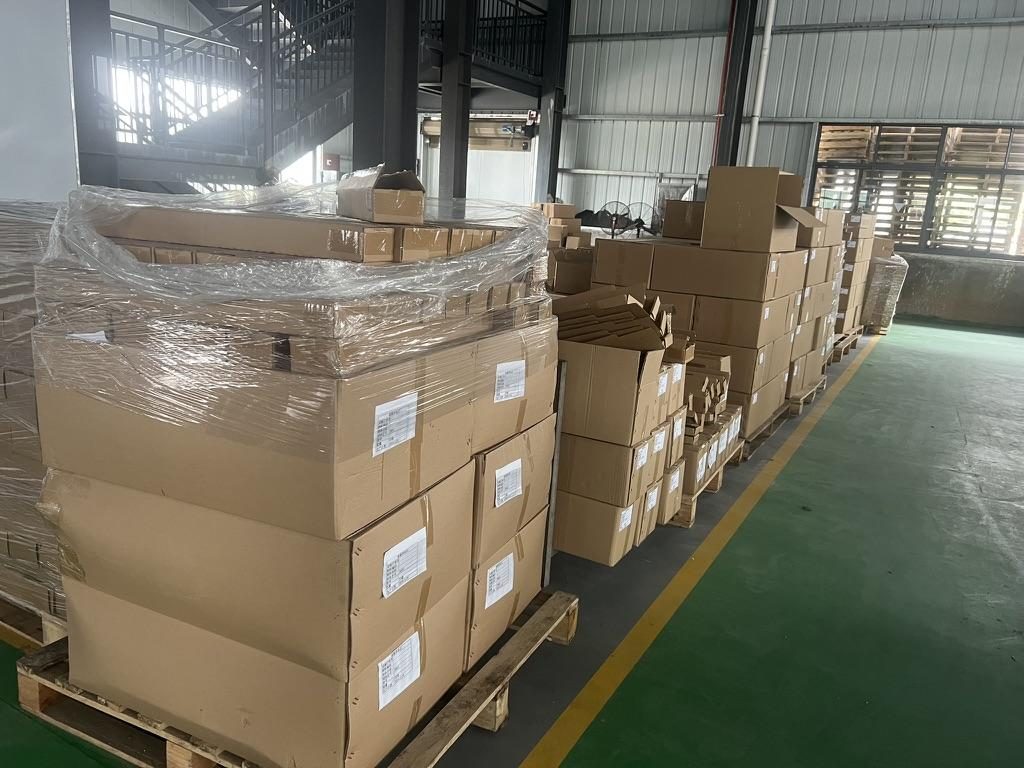
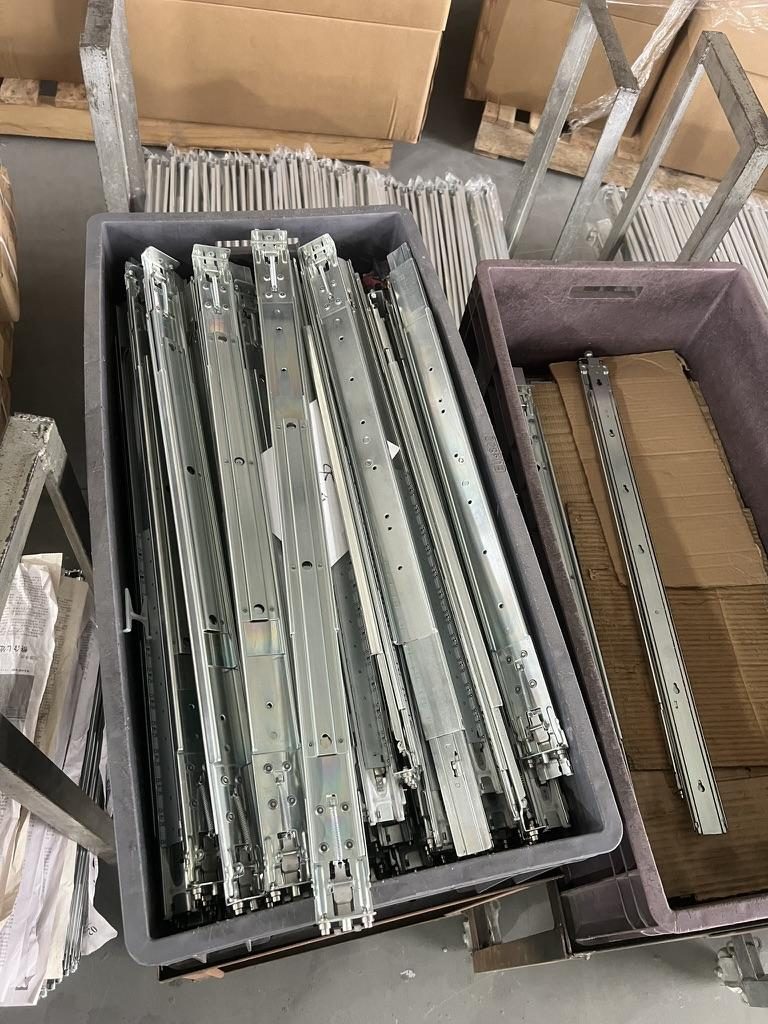 Rail kits packed in cartons before palletising
| Decision factor | Wholesale stock SKU | Bounded customization | Full OEM / private label |
|---|---|---|---|
| Unit price content | Hardware only | Hardware + fit adjustments | Hardware + engineering + branding |
| One-time cost | None | Minimal; typically no tooling fee for bounded changes | NRE and tooling for structural change, artwork, packaging |
| Minimum quantity | Set by stock run | Pilot quantities through production | Driven by dedicated run and print minimums |
| Lead time | Shortest, from stock | Sample stage, then production | Sample, artwork proofing, then production |
| Fit to your rack/chassis | Conditional — you adapt | Matched to your interfaces | Designed around one chassis and rack standard |
| Branding | None | None | Your artwork, labels and cartons |
| Warranty and support | Standard terms | Standard terms + engineering contact | Negotiated terms and agreed response times |
Two order sizes, two answers. A 500-pair order for a mid-size colocation operator and a 5,000-pair order for an enterprise refresh behave differently. At low hundreds, one-time cost dominates: tooling or NRE spread across a few hundred units adds a visible amount to every rail, and branded packaging minimums may exceed what the project actually needs — stock SKUs or bounded customization usually win. At multiple thousands the same one‑time cost is divided widely and stops mattering; private‑label print minimums become easy to absorb, dedicated runs and staged inventory become realistic, and the support and warranty savings start to count as well.
The break-even is simple arithmetic: (OEM unit premium − wholesale unit price) × quantity > one-time engineering + tooling + packaging setup. Solve for quantity, then compare it against your realistic 12‑month demand — not your first purchase order.
Compatibility & Fit: Mapping Rails to Rack and Server Models
Compatibility is a hard gate, not a checkbox. Run this sequence before you compare prices.
Decision rule (MetrixSlide engineering practice): hard gates first, preferences second. In order:
Step 1. Compatibility hard gates — rack architecture, hole type/thread, post‑to‑post distance, chassis interface, required load. If any hard gate fails, stop.
Step 2. Engineering feasibility — can an existing platform accept bounded changes (bracket position, hole pattern, rail length, rail thickness) without structural redevelopment? If yes, proceed as bounded customization. If not, expect NRE/tooling and longer lead times.
3. CAD fit and first‑article samples.
Step 4. Physical fit and performance validation (load, life). Passing each level is required before proceeding to the next.
Follow this practical validation sequence: Requirement → CAD → physical fit → performance. Passing one level never proves the next.
HARD GATES TO CHECK (short checklist)
- Rack architecture: 19‑inch (482.6 mm, IEC 60297 series / EIA-310‑D) vs OCP Open Rack V3 (21‑inch bay, different OU/RU pitch). Confirm which system the equipment will actually live in.
- Hole type and thread: square punched, round, or threaded (specify thread). Don’t assume interchangeability.
- Post‑to‑post distance (installed): measure the actual front‑to‑rear post spacing inside the cabinet; confirm it falls within the rail’s bracket adjustment range.
- Chassis interface: U‑height, actual width, depth, and exact rail‑to‑chassis interface method (T‑pin geometry, keyhole/J‑slot, M‑threads, captive screws).
- Load and extension state: specify per pair vs per rail, static vs dynamic, and whether rating applies at full extension.
Practical measurement notes and definitions (MetrixSlide practice)
- Closed length = the length of the rail assembly when fully retracted.
- Extended length = the length when fully extended.
- Bracket (fit) range = the front‑to‑rear post distances the outer brackets can span; this is the number to match to the installed rack. Never substitute closed length for bracket range.
Example compatibility issues from recent projects
- A North American telecom OEM required a friction 1U rail family that fit a post‑to‑post range with front posts measured roughly in the mid‑600s to upper‑900s mm range; the project also reduced pull‑out from a legacy 300 mm down to 150 ±3 mm for the installed lock‑out requirement. This change was handled as a bounded modification on an existing platform after engineering review.
- An Indian HPC ODM supplied a required post‑to‑post distance of approximately 812 mm inside their racks; an existing platform with a bracket adjustment range of 650–965 mm matched this without structural redesign.
- A SaaS company converting from stab‑in to drop‑in installation provided a PEM T‑pin spec (head Ø 6.502 mm, shaft Ø 4.0 mm, under‑head clearance 1.585 mm); MetrixSlide’s engineers treated the conversion as an inner‑rail J‑slot redesign only (bounded change) and proceeded to CAD and samples.
- A Korean surveillance‑equipment maker asked for an ultra‑slim rail to suit a 4U NVR body (~440 mm) with a request to evaluate rail thickness at ≤5 mm; MetrixSlide evaluated platform limits and advised that thickness changes require a performance check against sag and load.
| Field | What to record | Validation status |
|---|---|---|
| Rack architecture | 19‑inch EIA / OCP ORv3 and which standard/OU/RU applies | Requirement |
| Hole type / thread | Square, round, or threaded + thread spec | Requirement |
| Post-to-post distance | Measured in the installed rack; compare to bracket range | Requirement |
| Chassis U-height and width | Nominal U plus measured width | CAD |
| Chassis interface | T‑pin, keyhole/J‑slot, M‑thread, captive screw | CAD |
| Mounting style | Tool‑less, screw, stab‑in, drop‑in | Physical fit |
| Load | per pair or per rail; static/dynamic; extension state | Performance |
 MS-TLS-120 Tool-less Ball Bearing Server Rail Kit — view product
Installation attributes and taxonomy (MetrixSlide view)
MetrixSlide classifies rails across orthogonal axes:
- Motion / support architecture: Sliding vs Fixed.
- Sliding mechanism (if sliding): Ball‑bearing vs Friction.
- Mounting/installation attribute: Tool‑less vs Screw/hardware; Stab‑in vs Drop‑in (installation sequence / inner‑rail J‑slot shape), etc.
These axes coexist: a sliding rail can be ball‑bearing and tool‑less; a universal bracket can be tool‑less. Use this taxonomy when specifying preferences only after hard gates are met.
Materials, Build Quality and Testing Standards
Once fit is confirmed, reliability is decided by a few material and process factors. Ask for each one explicitly.
- Rail thickness and steel grade. Thicker material resists sag at full extension; thinner material reduces weight and cost. Treat any thickness change as an engineering decision, not a price lever. MetrixSlide evaluates thickness changes against the platform’s stiffness and load performance.
- Finish. Zinc plating, electrocoat and powder coating behave differently against corrosion and abrasion. Ask what the finish is specified for — indoor data hall, dusty plant floor, or humid edge cabinet.
- Mechanism. Ball‑bearing slides carry higher loads and run smoother; friction slides are simpler, quieter to service and lower cost. Section count (two‑ or three‑section) determines how far the chassis extends and the service envelope.
- Load rating definition. A rating means nothing without the qualifiers: per pair or per rail; static or dynamic; extension state; test fixture; duration; and acceptance criteria. MetrixSlide’s heavy‑duty GPU rail has a nominal capacity of up to 180 kg per pair; a formal test report at that load is not yet available. Never multiply a per‑rail figure without an agreed test case.
Testing and certification. MetrixSlide is ISO 9001:2015 certified and uses a patented anti-sag slide structure. In the factory static‑load test a rail pair is held under load at full extension for 24 hours, and the MS‑FMR‑2U‑100 held 100 kg in that test. Many suppliers never publish life‑cycle or load‑test reports — request third‑party test data, and if your end product must satisfy system‑level standards (for example UL/CSA 62368), ask for the load evidence that supports it.
Spotting weak product. Check weld consistency at bracket joints, coating uniformity inside the slide channel, hole alignment across inner and outer rails, and whether part numbers and logos match across a shipment. Mismatched markings usually mean mixed batches.
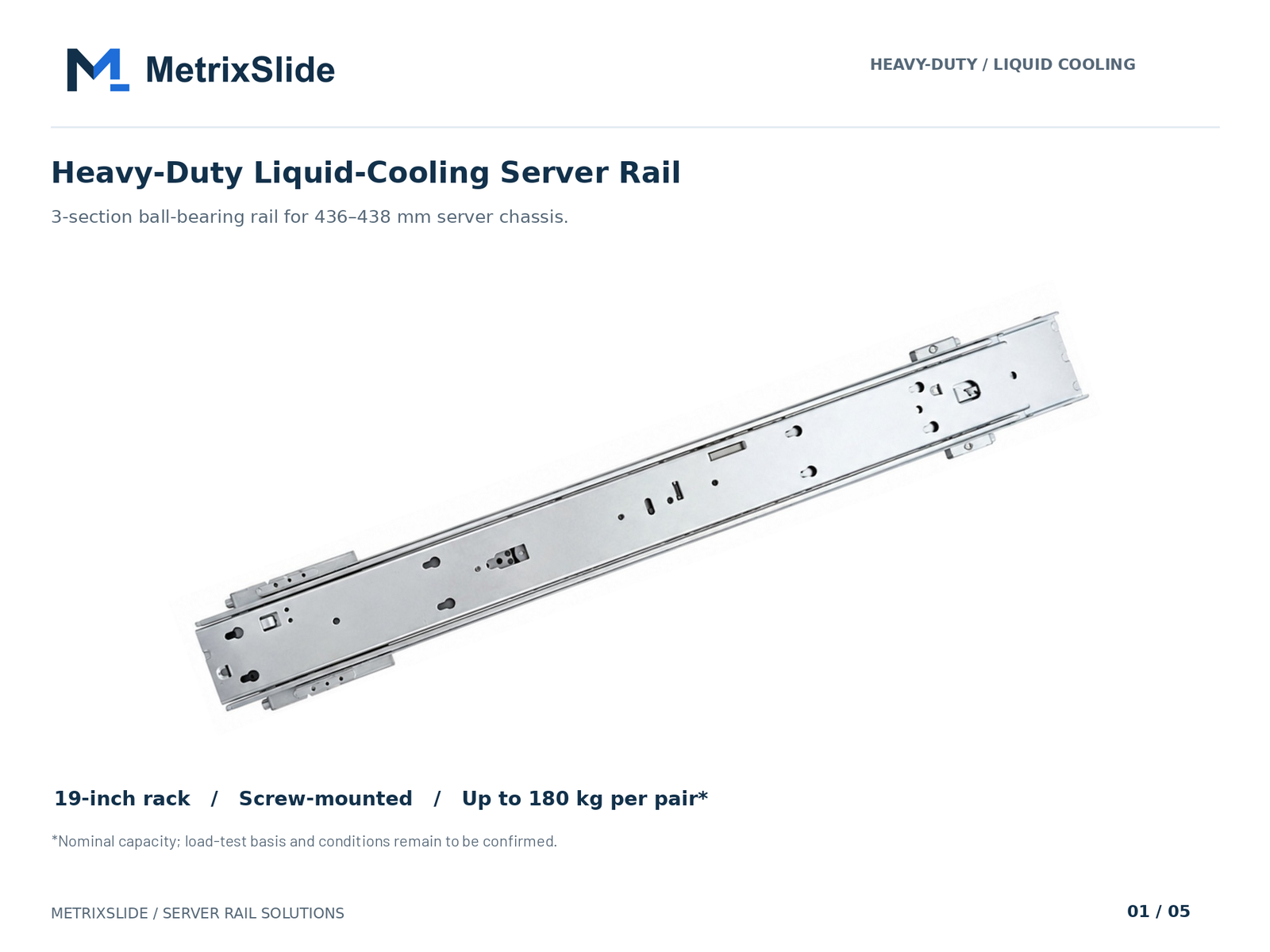 MS-BBR-180 Heavy-Duty Liquid-Cooling Server Rail — view product
Supply Chain, Lead Times, Samples and Logistics for Bulk Orders
Sample program. On custom rail projects, samples typically run roughly 15–20 days after order confirmation, depending on whether new brackets or dies are involved. Ask three questions up front: what the sample costs, whether it is credited against the production order, and who pays return freight if the sample is rejected.
Tooling. Structural change or a 1:1 copy of an existing rail requires NRE and tooling. Bounded changes — bracket position, hole pattern, rail length, rail thickness — normally do not.
Production and split shipments. Production schedules are quoted per project, so get the schedule in writing with milestones rather than a single delivery date, and plan a first‑article approval step before the balance ships. For large orders, split shipments let you start installation while later batches are still in production.
Logistics and landed cost. Sea freight is the default for bulk; air freight is for samples and line‑down emergencies. Decide early whether you are buying FOB or DDP — duty, customs clearance, port fees and inland drayage land on someone, and the cheapest unit price often becomes the most expensive landed cost. Build your landed‑cost model as: unit price × quantity + one‑time costs + freight + duty + clearance + inland transport + warehousing.
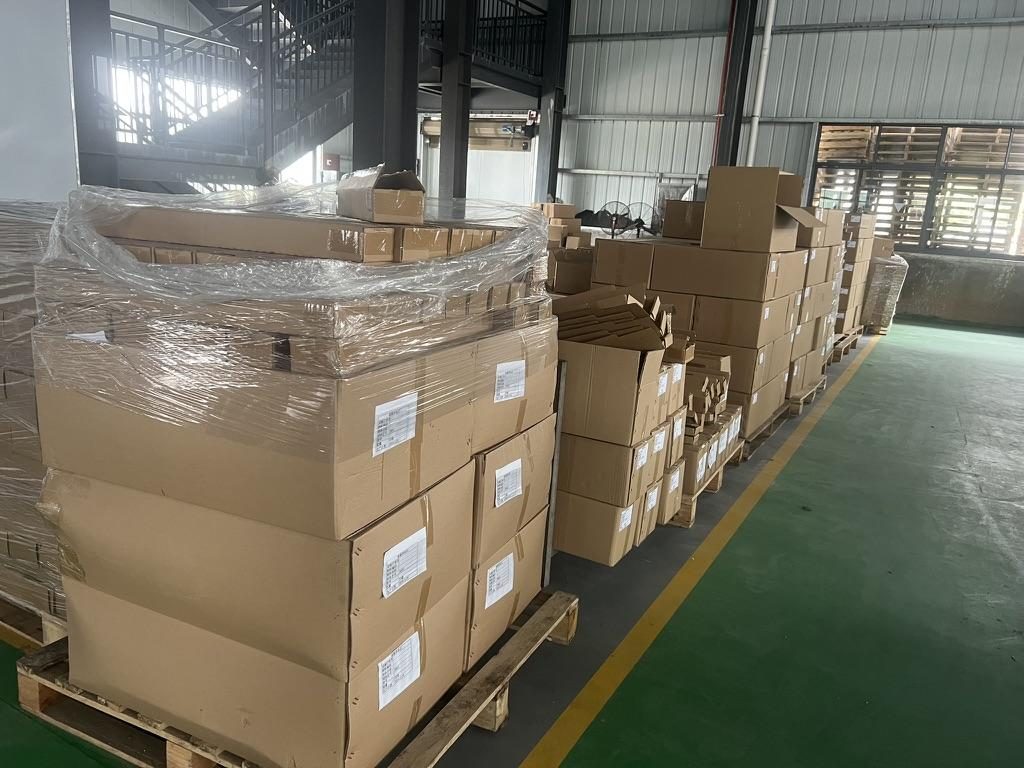 Export cartons of server rail kits ready to ship
Supplier due diligence checklist — factory and production‑line photos, stated monthly capacity, ISO 9001:2015 certification scope, documented revision control on drawings, available test reports, and a named engineering contact. If a supplier cannot show you the process, assume the process is not controlled.
Warranty, Returns, Technical Support and Private-Label Customization
Wholesale vs private label, commercially.
- Warranty. Wholesale purchases run on standard terms. Private‑label programs negotiate coverage — which components are covered, for how long, and whether finish corrosion is included. Get the coverage scope in writing rather than assuming it.
- RMA. Ask for the RMA flow before you order: how a claim is raised, typical turnaround, and who pays return and replacement freight. On bulk orders this line item can exceed the price difference between suppliers.
- Technical support. Wholesale buyers usually reach a sales contact. Private‑label buyers should expect an engineering contact for interface questions, drawing revisions and change control.
- Contract clauses that reduce risk. Define acceptance criteria (drawing‑based, with tolerances), warranty scope and duration, RMA turnaround, freight responsibility, design‑freeze rules, and spare‑parts availability for the life of the program.
The private‑label process. Artwork and packaging design start from your brand assets; the supplier produces a carton proof or printed label sample for your approval before mass printing. Expect print minimums on cartons and labels, and confirm labeling content — model identification, load rating statement and any warnings — before production. Sequence it as artwork → proof approval → label and carton production → rail production → final packing, and add that packaging time to your time‑to‑market plan. At low volume, packaging setup is a meaningful share of unit cost; at high volume it fades into rounding.
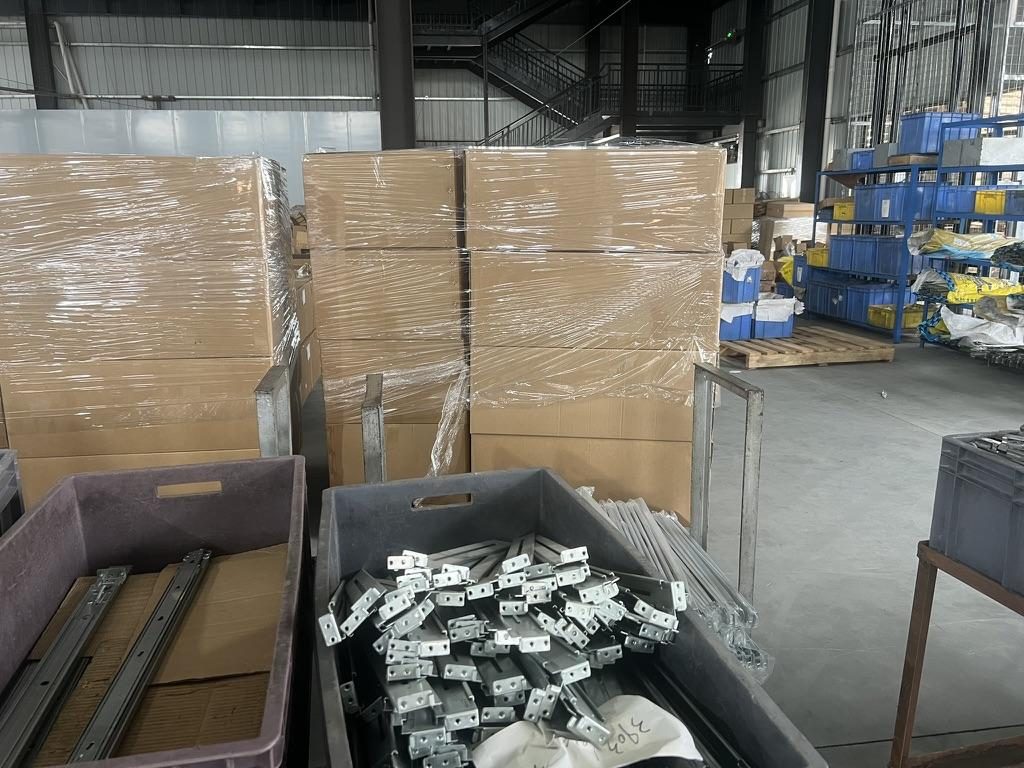 Finished server rails being packed for shipment
Practical checklists and vendor inputs (MetrixSlide OEM intake)
What to send with an RFQ or to have on hand for a compatibility review:
Chassis‑side intake
- U height; actual width; depth/engagement envelope.
- Rail‑to‑chassis method and all interface CAD (T‑pin head Ø, shaft Ø, under‑head clearance, centre spacing, quantity).
- Any captive screw or special front‑face fastening dimensions (note: front‑screw centre differences of a few millimetres can shift the U‑position).
- Target load per chassis, and whether rating must be static/dynamic and at full extension.
Rack‑side intake
- Rack architecture (19‑inch / EIA‑310‑D vs OCP ORv3).
- Hole type + thread spec (square punched dimensions, round Ø, threaded size).
- Photo of the post with a tape measure and the installed front‑to‑rear post distance (or the measured range).
Project flow (MetrixSlide OEM logic) Requirement → identify existing rail platform → classify requested changes (bounded vs structural) → engineering feasibility review → CAD/drawing output → customer review → sample → physical validation → design freeze → production.
FAQ
How much cheaper are wholesale server rails than OEM rails per unit, and what about MOQs and tiers? Wholesale rails are cheaper per unit because you are not paying for engineering, tooling or branded packaging, and the gap widens as volume rises. MOQ and discount tiers are quoted per project, because minimums track material run length, finishing batch and packing format rather than a fixed catalogue rule. Ask any supplier for the quantity ladder in writing and for the assumption behind each step.
How do I verify that a third-party rail will fit my server and rack? Measure four things: rack architecture (19-inch EIA-310-D or OCP ORv3), hole type and thread spec, actual post-to-post distance inside the installed rack, and the chassis interface (U-height, width, T-pin or keyhole geometry, screw pattern). Then confirm the rail's bracket adjustment range covers your measured post distance and that the load rating states per pair, static or dynamic, and extension state. Cross-reference against the OEM rail part number where one exists, then validate with a physical sample — CAD alone never proves fit.
What materials, load ratings and test documentation should I require? Require a stated rail thickness and steel grade, a named finish and what it is specified against, and a load rating that defines per pair versus per rail, static versus dynamic, extension state, fixture, duration and acceptance criteria. Ask for third-party load or life-cycle test reports rather than a marketing number, and if your system must meet UL/CSA 62368, request the load evidence that supports the system-level file.
What lead times, sample timelines and tooling costs are realistic for private-label rails in bulk? Samples on custom projects typically run about 15–20 days after order confirmation, before artwork and packaging proofing for a branded program. Bounded changes — bracket position, hole pattern, rail length, rail thickness — normally carry no tooling fee, while structural changes or a 1:1 copy of an existing rail require NRE and tooling. Production schedules are quoted per project, so ask for written milestones and plan a first-article approval before the balance ships.
How do warranty, RMA and technical support differ between wholesale and private label? Wholesale purchases run on standard warranty terms with a sales contact for support. Private-label programs negotiate warranty scope, RMA turnaround and freight responsibility, and come with an engineering contact for interface and revision questions. Whatever the model, write acceptance criteria, warranty coverage, RMA turnaround, freight responsibility and design-freeze rules into the purchase contract.
Talk to a MetrixSlide engineer
Ready to move from research to a real quote? Send us a chassis drawing or model (STEP or DWG), the rack post-to-post distance and hole type, the expected load and your planned quantities. Within 24 hours you get a rail matching proposal from an engineer, followed by 2D/3D drawings for review and sample pairs (typically 15–20 days after drawing approval) for physical validation before the full order.
Bracket position, hole pattern, rail length and thickness adjustments on our existing platforms usually carry no tooling fee; structural redesigns are quoted separately with dies made in-house.