
A practical guide for procurement and engineering teams on the one-time engineering (NRE) and per-unit factors that determine custom server rail cost.
End-to-End Cost Breakdown: NRE, Tooling, and Prototype Expenses
Custom server‑rail projects combine one‑time engineering (NRE) and tooling expenses with repeatable per‑unit manufacturing cost. Procurement should insist on an itemized NRE quote so you can compare proposals and understand which activities are being amortized into the unit price.
What to expect as line items (ask suppliers to break these out)
- Requirements capture and specification work (rack type, chassis features, mounting method, expected load per pair).
- CAD, DFM and drawing iterations (clearance checks, hole/pin fit, closed/extended/bracket‑range verification).
- Prototype fabrication and sample builds (CNC parts, hand fixtures, 3D printed checks).
- Soft tooling and jigs used for low‑volume validation.
- Hard tooling (stamping/progressive dies) and die try‑out when structural redevelopments are required.
- Test fixtures, load rigs and first‑article inspection (FAI) preparation.
- Sample certification paperwork where the buyer requires formal records.
Why you should get these as separate line items
- Different line items amortize differently (engineering hours versus durable die cost).
- Knowing the per‑revision or per‑change engineering rate lets you model revision risk.
- Some changes (bracket position, hole‑pattern, small length adjustments) may be handled as bounded customization on an existing platform; structural redevelopments usually cause new tooling and larger NRE.
MetrixSlide engineering practice (what we check early)
- Compatibility hard gates first: interface fit (rack holes / post distance / chassis engagement) and load requirement → only then choose preferred architecture (ball‑bearing vs friction, full‑extension travel, tool‑less).
- Development flow: Requirement → CAD / DFM → physical sample → performance validation → design freeze → production.
- When assessing a quoted rail, ask for the “decision tree” that maps which kinds of changes trigger tooling rework vs a simple drawing revision.
Note on supplier pricing disclosures
- Published hourly rates, prototype or die prices vary widely by supplier and region. If a vendor offers ranges without itemization, insist they show the per‑activity breakout so you can amortize or negotiate.
Definitions that matter to cost and scope
- Closed length: the rail length with the inner/member(s) condensed. Do not use this alone to infer mounting depth.
- Extended length (full extension): the outermost deployed length of the rail set.
- Bracket range (mounting fit range): the span the rail’s brackets can cover on the rack posts (this is the value you must compare with the actual post‑to‑post distance in the target rack).
- Pull‑out / lock‑out travel: the distance the inner member extends from closed position to the lock‑out; reduced pull‑out specifications can simplify tooling and reduce late‑stage revisions.
A quick drawing example from MetrixSlide engineering evidence
- Model family examples show closed / extended values as separate drawing entries (e.g. a family pair with 650 ±3 mm closed → 810 ±3 mm extended). Always request both numbers and the bracket‑range.
Amortization and Per‑Unit Pricing: How to Spread NRE and Tooling Costs
Per‑unit NRE contribution = (Total NRE + Tooling cost) ÷ Production quantity.
What to ask a supplier for a meaningful amortization model
- Show tooling life assumptions (how many good parts before a rebuild).
- State how many revisions are included in the quoted NRE and the per‑revision cost thereafter.
- State whether tooling is billed up‑front, staged or recovered via per‑unit surcharges.
- Provide per‑unit manufacturing cost at planned batch sizes (so you can model break‑even points).
Practical guidance
- Small first runs (10–50 pairs) are common for physical validation; explicit sample lead‑time expectations (see Lead Times below) are essential for planning.
- For low volumes, soft tooling and incremental validation reduce risk; for stable high volumes, harder tooling can reduce steady‑state per‑piece cost but raises upfront amortization.
- Ask for a “what‑if”: show per‑unit price at your planned quantity and at the next standard break (e.g., a higher batch) so you can decide whether to invest more in tooling.
Manufacturing Variables that Change Costs: Materials, Finishes, and Process Steps
Material and process choices directly affect per‑unit cost, tooling life and validation effort.
Material notes from MetrixSlide practice
- Cold‑rolled steel is a common baseline because it stamps and forms well.
- Stainless or aluminium choices change tooling/press settings and sometimes fastener strategy; such material shifts should be treated as an engineering change that can affect NRE/tooling.
- MetrixSlide engineering assesses whether a requested thickness change is a bounded modification on an existing platform or a structural redevelopment that requires new tooling.
Finishes and lifecycle tradeoffs
- Choose finish to match the operating environment (e.g., higher‑corrosion environments may justify powder coat or anodize despite higher unit cost and handling).
- Specify finish clearly in the RFQ so the impact on process steps and cycle time is included in quotes.
Process steps that drive cost
- Stamping/progressive dies: high upfront but low per‑piece at volume.
- Secondary bending/forming: each secondary operation adds labour or cycle time.
- Welding / spot welding: can add NRE for automated cells.
- Fastener strategy (PEM inserts, T‑pins, screws) affects assembly labour and sample tooling needs.
Quality, testing and certification
- Ask vendors to document the CAD → sample → load test sequence: in MetrixSlide’s factory static‑load test a rail pair is held under load at full extension for 24 hours, and the MS‑FMR‑2U‑100 held 100 kg in that test.
- MetrixSlide’s factory is ISO 9001:2015 certified for the processing of metal slides; seek that level of process traceability when validation evidence is required.
- Some designs use patented anti‑sag features to reduce deflection at full extension; ask for the test evidence that supports any anti‑sag claim.
Taxonomy: architecture choices and when they change cost
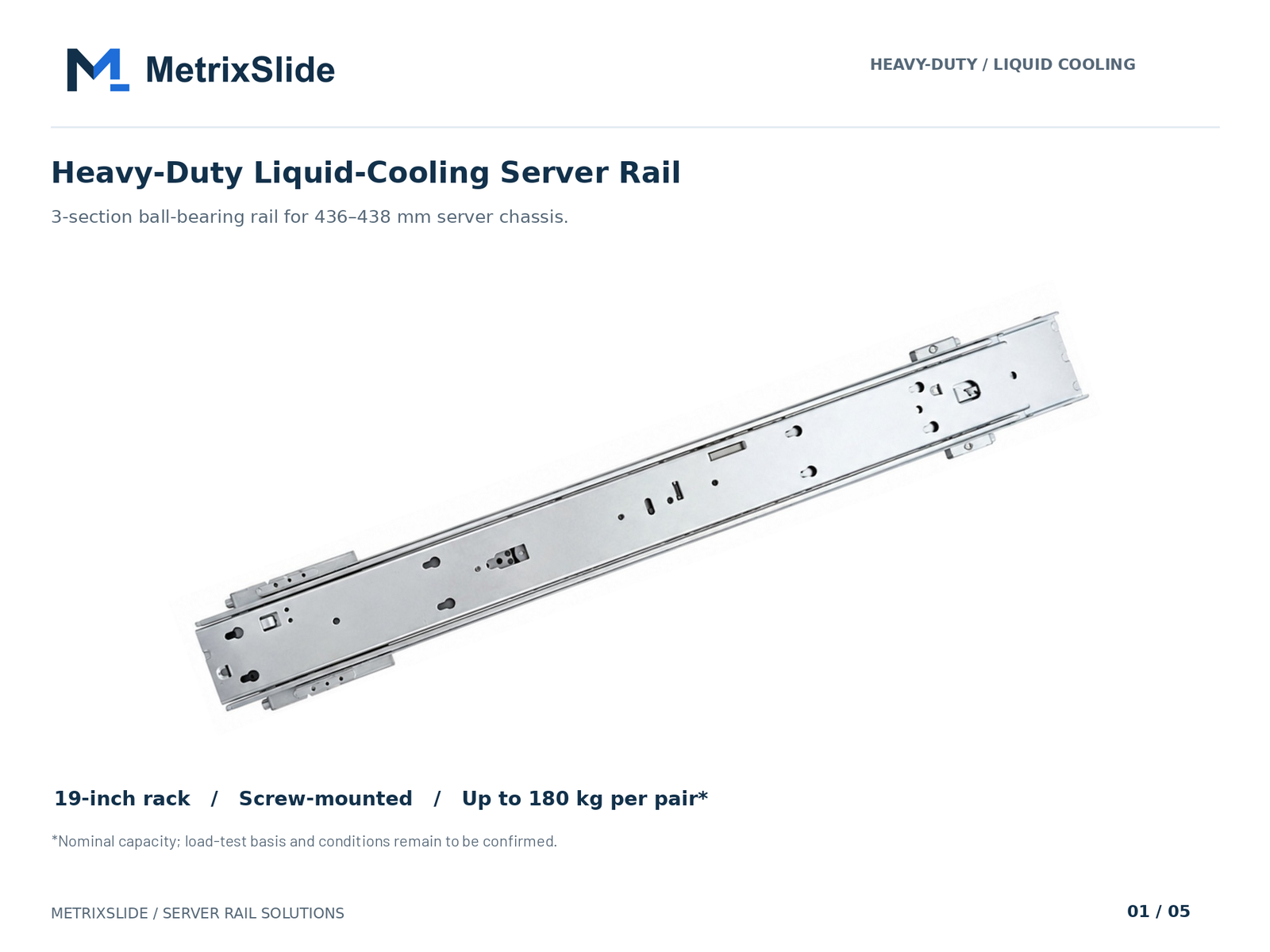 MS-BBR-180 Heavy-Duty Liquid-Cooling Server Rail — view product
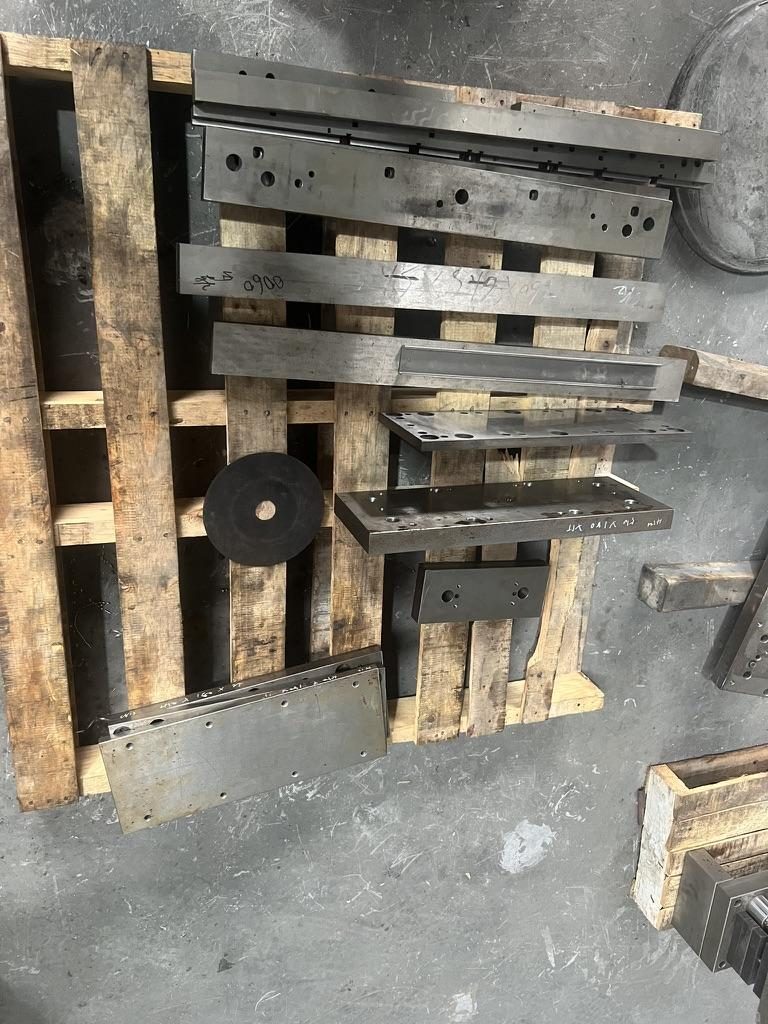
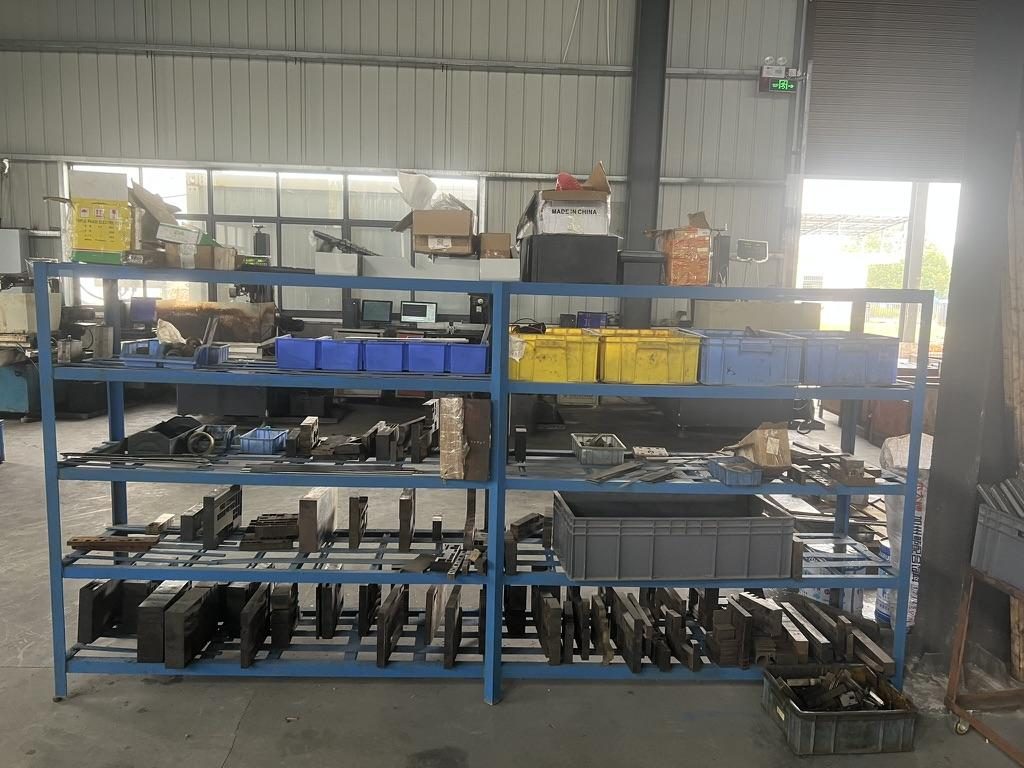
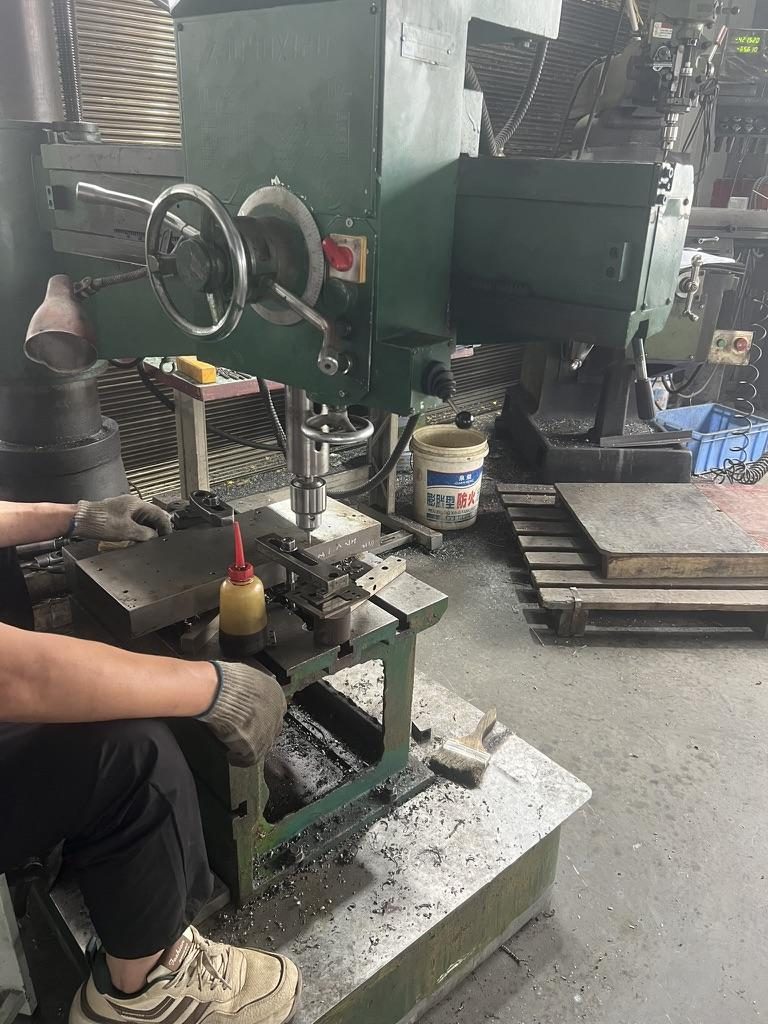 Tooling workshop: machining a component of a custom rail die
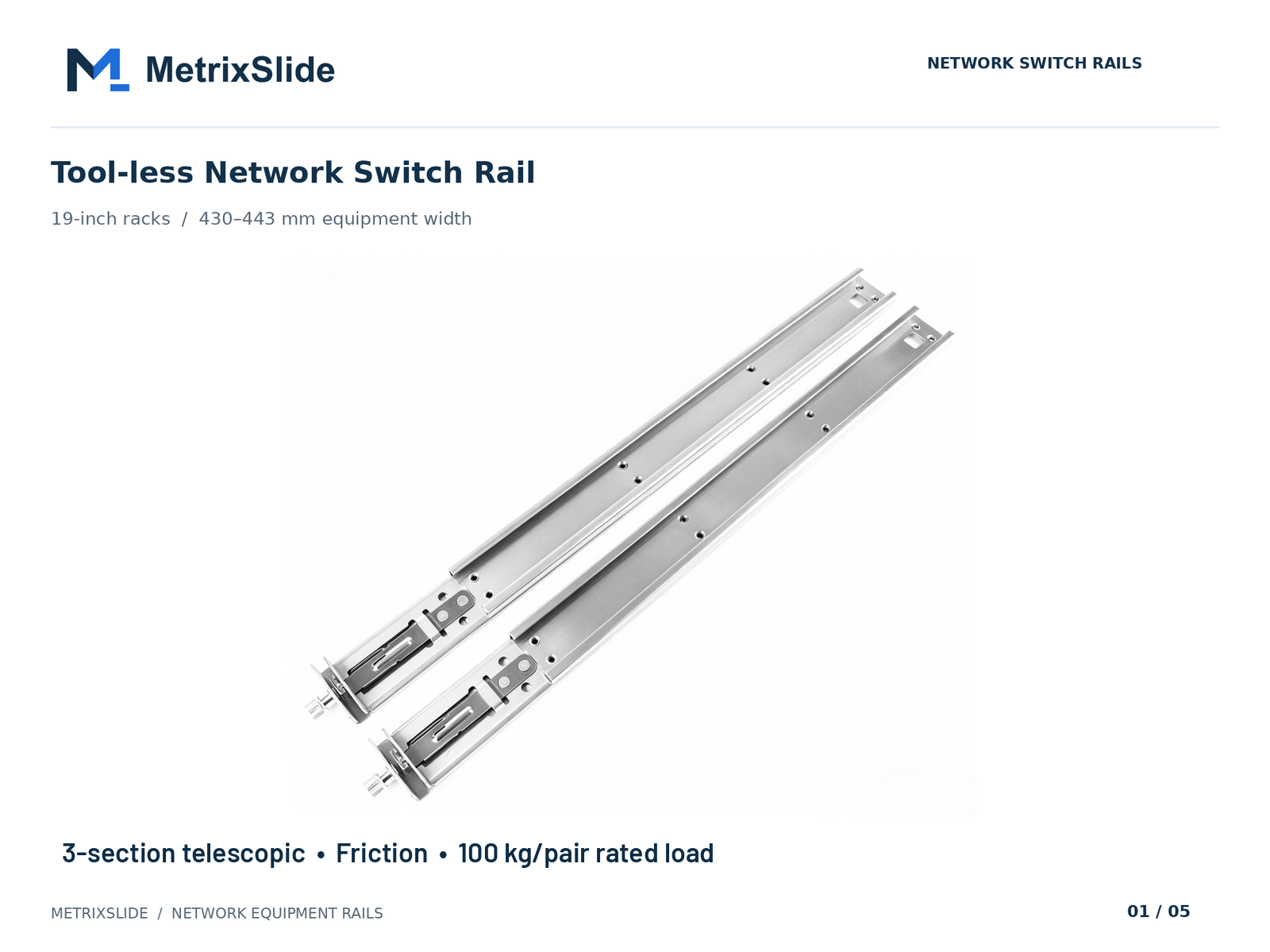 MS-FMR-SW-100 Tool-less Network Switch Rail — view product
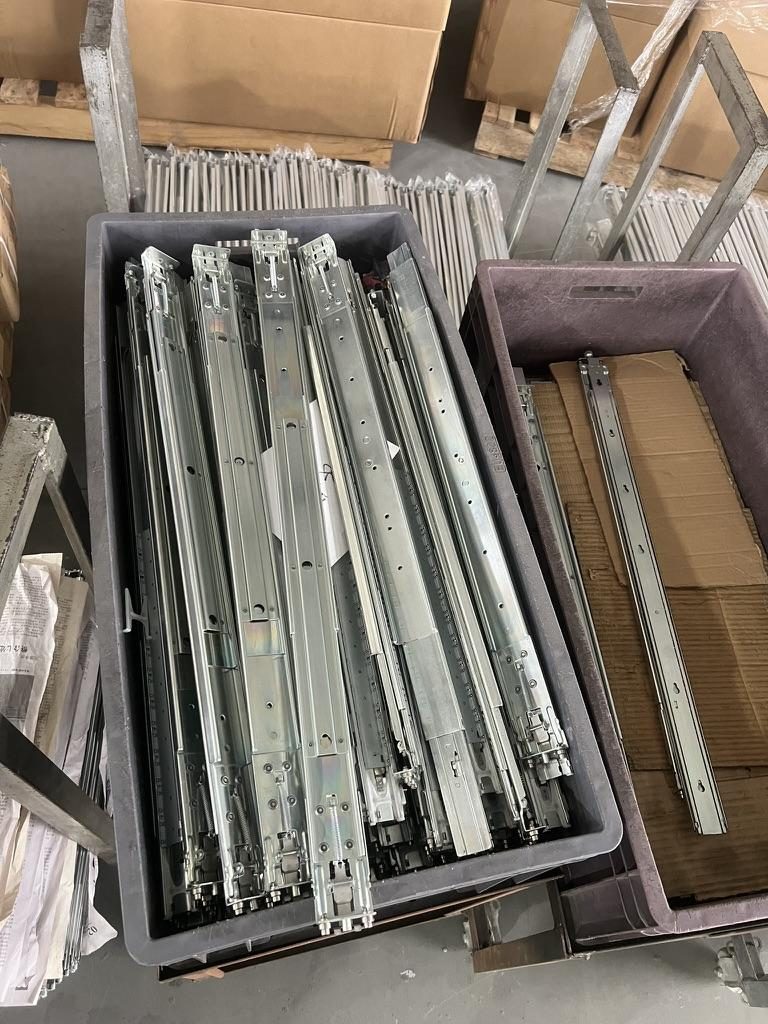
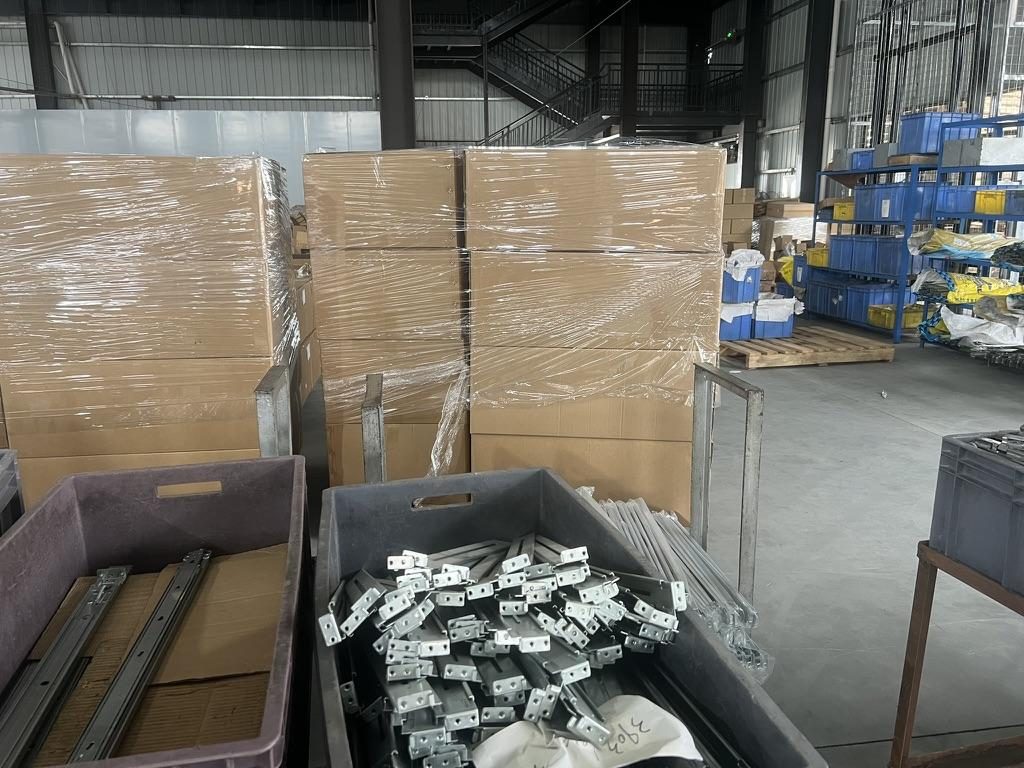
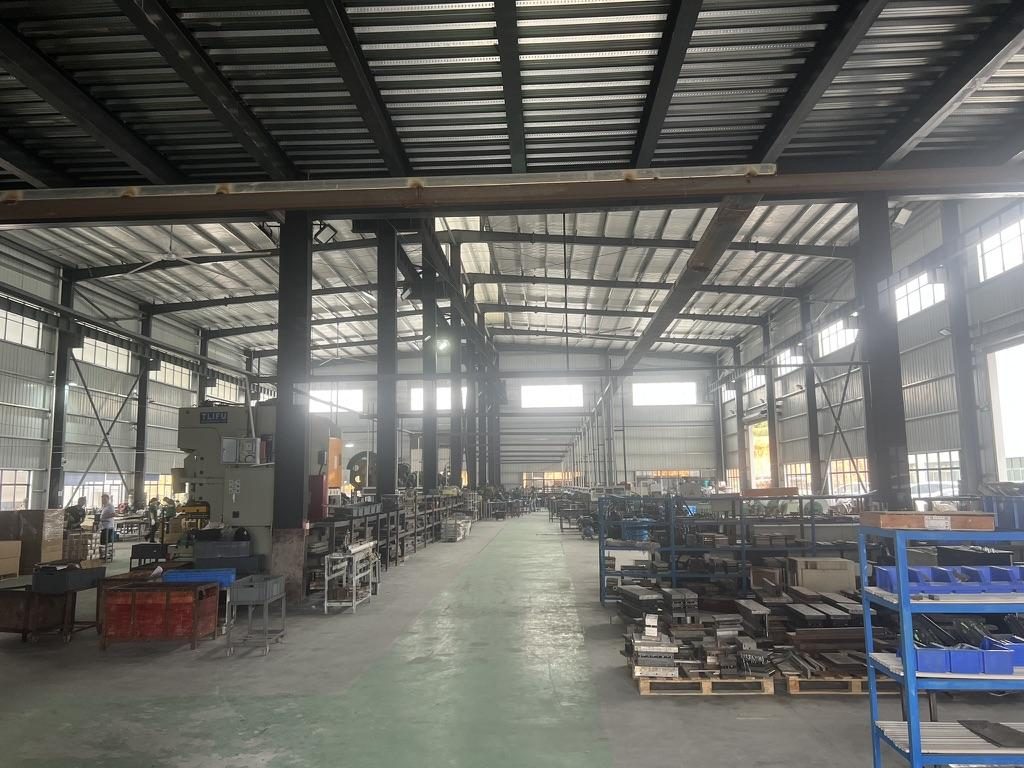 Overview of the server rail production workshop
Make these compatibility gates before you make preference decisions.
- Motion architecture: fixed vs sliding (telescoping two‑ or three‑section). Fixed supports are low cost; sliding requires more parts and validation.
- Sliding mechanism: ball‑bearing vs friction. Ball‑bearing is favoured for higher loads and smoother travel; friction can be very compact.
- Mounting method: tool‑less vs screw / PEM / T‑pin / keyhole. Universal brackets increase fit flexibility but may add cost.
- Installation interface: stab‑in vs drop‑in. A drop‑in conversion is commonly an inner‑rail J‑slot redesign; it can be handled as a bounded interface change in many families but still requires CAD → sample → validation.
Lead Times, Rush Fees, and Supply Chain Logistics
Plan lead times into total landed cost; MetrixSlide practice reports a reliable sample lead time and treats other timing as supplier‑specific.
What MetrixSlide evidence supports
- Sample pairs (prototype/first article) are commonly delivered in roughly 15–20 days after drawing approval for typical small runs.
- Other milestones (soft tooling, hard die manufacture, die try‑out) vary significantly by supplier, complexity and current factory schedule. Treat these as supplier‑specific and ask for explicit calendar commitments in the quote.
Logistics to include in landed cost
- Freight mode, duties and brokerage add to unit landed cost.
- Inventory carrying should be modelled as a percentage of the order value for longer lead times.
- Hybrid approaches are common: local quick samples for acceptance followed by offshore series production when unit cost dominates.
Operational tips
- Build buffer time for die try‑out and first‑run tweaks.
- Define rush‑fee triggers contractually (e.g., calendar days from drawing approval) and pre‑agree on acceptance testing for expedited runs.
Reducing Costs: DFM, change control and MetrixSlide case highlights
Design‑for‑manufacturability (DFM) actions
- Keep bracket and hole patterns aligned with a small number of standard variants to avoid separate dies.
- Minimise secondary bends where possible; collapsing features into progressive tools can reduce per‑unit labour at volume.
- Use bounded customization where possible (bracket shifts, hole‑pattern, small length/thickness adjustments) rather than full structural redevelopment.
Change‑order control (MetrixSlide practice)
- Define a set number of included drawing revisions in the NRE scope and publish the per‑revision fee after that limit.
- Explicitly label change types in the contract: “bounded” (bracket/hole/length‑within‑range) versus “structural” (new envelope, new member geometry).
- Require a written impact assessment and price before implementation of changes.
Anonymized engineering examples (real figures drawn from MetrixSlide case evidence)
- A North American telecom OEM — a 1U friction rail project where the customer tightened the pull‑out spec: initial travel ~300 mm was reviewed and the customer moved to a reduced lock‑out target (~150 ±3 mm). Handling the reduced pull‑out as a defined spec early reduced late rework on die features and avoided an expensive die rework cycle.
- An Indian HPC ODM — required a 2U ball‑bearing rail to fit a chassis 434 mm wide and a bracket range 650–965 mm. The customer's actual post distance clustered near ~812 mm; confirming the actual post distance against the bracket range avoided a costly rework.
- A Korean surveillance‑equipment maker — requested an ultra‑slim 4U rail and preferred very thin material (≤5 mm was requested as a target). MetrixSlide engineering first chose a candidate platform (one of the ultra‑slim families) and then derived an M4 hole pattern so the customer could reproduce the chassis side interface without extra T‑pins.
- A SaaS company building its own servers — a stab‑in → drop‑in conversion was handled as an inner‑rail J‑slot redesign only after the chassis T‑pin spec was confirmed (PEM SKS‑R1.5‑4‑0: head Ø 6.502 mm / shaft Ø 4 mm / under‑head clearance 1.585 mm). That focused scope avoided a wholesale envelope redesign for three family members whose closed/extended lengths stayed within the family tolerance (e.g., 650 ±3 → 810 ±3 mm; 800 ±3 → 810 ±3 mm; 950 ±3 → 970 ±3 mm).
Per‑pair rating example
- MetrixSlide product documentation states capacities per pair; an example model, MS-BBR-180, has a nominal capacity of up to 180 kg per pair, and a formal test report at that load is not yet available. Always confirm whether a quoted rating is per‑pair or per‑rail, static or dynamic, and which extension state it applies to.
Tactical approaches for small batches
- Use soft tooling and a prototype run to validate installation and hole alignment before commissioning progressive dies.
- Negotiate that small bracket or hole‑pattern adjustments within the existing die blank and bend envelope are handled as engineering revisions rather than a die rebuild (get this in writing).
What to send with your RFQ (MetrixSlide intake checklist)
At minimum include:
- Chassis drawing or STEP model (key features and datums).
- Rack post‑to‑post distance or bracket range and hole type (photo + measurement helps).
- Expected load per pair, and whether that load must be met at full extension or in a locked position.
- Desired material and finish options (or state “application environment” so supplier can recommend).
- Planned first‑order quantity and expected reorder cadence.
- Target installation method (stab‑in or drop‑in, tool‑less, T‑pin specification if used).
- Any must‑pass tests (e.g., 24‑hour static test, lock‑out travel).
Conversion / CTA
Before requesting bids, prepare your chassis drawing or STEP file, rack post‑to‑post distance (or bracket range), expected load per pair, desired finish/material choices, and planned first‑order quantity. Ask for a rail‑matching proposal with recommended architecture, an itemized quote (NRE/tooling broken out), drawings and sample lead‑time estimates. To compare scenarios, use a simple table with columns for NRE, tooling, per‑unit cost at planned quantities, and lead time.
FAQ
Q: What does NRE include for a custom server rail and what typical price ranges should I expect in the U.S?
A: NRE typically includes engineering time for CAD/DFM, prototype fabrication, test‑fixture creation, and tooling design/try‑out. In U.S. market practice, engineering billing often falls in the $80–$200/hr band, soft tooling/prototype runs can be in the low‑thousands, and hard stamping dies commonly fall into a mid‑five‑figure range; exact numbers depend on complexity.
Q: How do I calculate per‑unit cost after amortizing tooling and NRE across different MOQs?
A: Use the simple formula: (Total NRE + Tooling) ÷ Planned Production Quantity = per‑unit NRE contribution. Then add the steady‑state per‑piece manufacturing cost. Run scenarios across MOQs (100 / 500 / 1,000 / 5,000) to identify break‑even points and whether investing in longer‑life tooling is justified.
Q: What are realistic lead times for prototypes, soft tooling, and hard tooling, and how much do rush fees usually add?
A: Typical industry timing is prototypes in 1–4 weeks, soft tooling 3–6 weeks, and hard tooling 6–12 weeks. Rush fees vary but are commonly charged as a percentage premium or as per‑unit expedited surcharges; expect meaningful increases for calendar compression or air freight.
Q: Which material and finish choices most affect per‑unit price and durability for server rails?
A: Material (cold‑rolled steel vs stainless vs aluminum) is the primary driver of raw‑material cost and tooling behavior; finishes (phosphate/zinc, powder coat, anodize) determine corrosion resistance and service life. Choose material and finish to match the operating environment and lifecycle expectations; higher‑durability choices raise upfront per‑unit cost but can lower total lifecycle cost.
Q: What minimum order quantities and volume discount thresholds are common for custom rack rails?
A: Minimums depend on whether you use soft or hard tooling; small prototype batches (10–50 pairs) are common, but durable per‑unit price improvements appear at several hundred to thousand‑unit MOQs. Ask suppliers for explicit per‑unit pricing at MOQ 100 / 500 / 1,000 / 5,000 to see the sensitivity.
Talk to a MetrixSlide engineer
Ready to move from research to a real quote? Send us a chassis drawing or model (STEP or DWG), the rack post-to-post distance and hole type, the expected load and your planned quantities. Within 24 hours you get a rail matching proposal from an engineer, followed by 2D/3D drawings for review and sample pairs (typically 15–20 days after drawing approval) for physical validation before the full order.
Bracket position, hole pattern, rail length and thickness adjustments on our existing platforms usually carry no tooling fee; structural redesigns are quoted separately with dies made in-house.