
Three numbers decide the length of a server rail: the front-to-rear post distance of the rack (the mounting depth), the depth of the chassis, and the travel you need when the server slides out. A rail is specified against those numbers by an adjustable bracket range (minimum to maximum post distance), a closed length, and a travel or extension length. This article covers the arithmetic and the decision; for the definitions, see mounting depth vs rack depth vs chassis depth and which chassis dimensions matter for rail fit.
The four dimensions on a rail drawing
Every rail drawing carries four length-related dimensions. For the full reading guide, see how to read a server rail drawing.
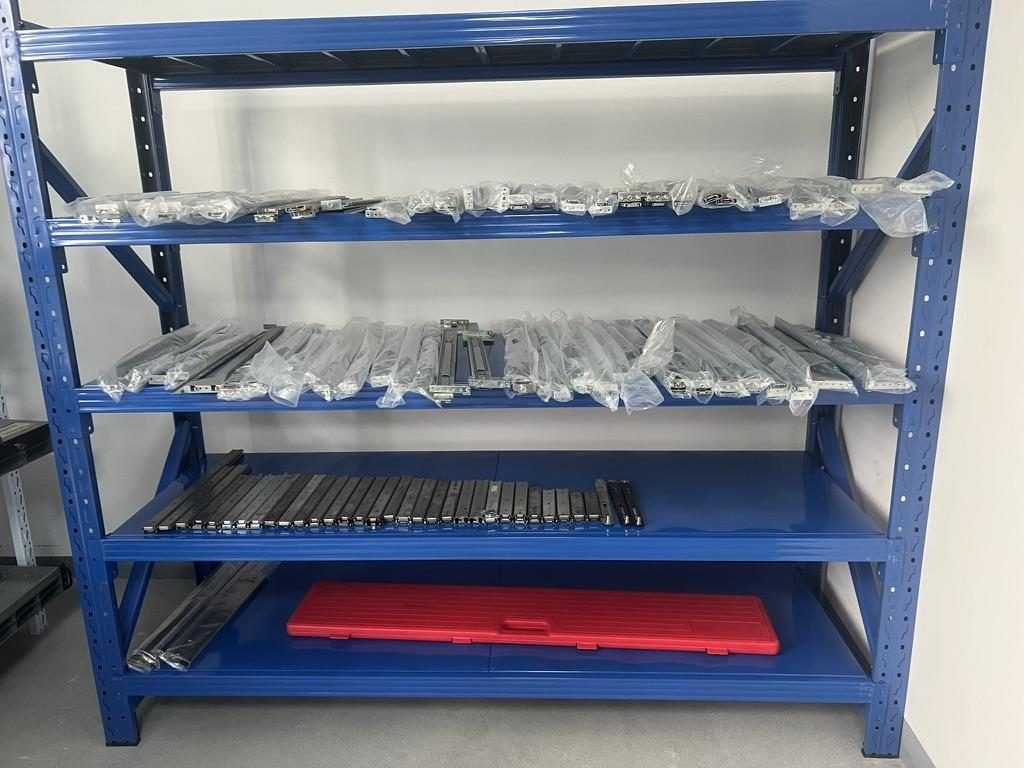
- Bracket adjustment range. The minimum and maximum post distance the outer (rack) member can span, measured between the faces that sit against the front and rear posts. It must include your measured post distance with margin, so the bracket is not at the end of its slot.
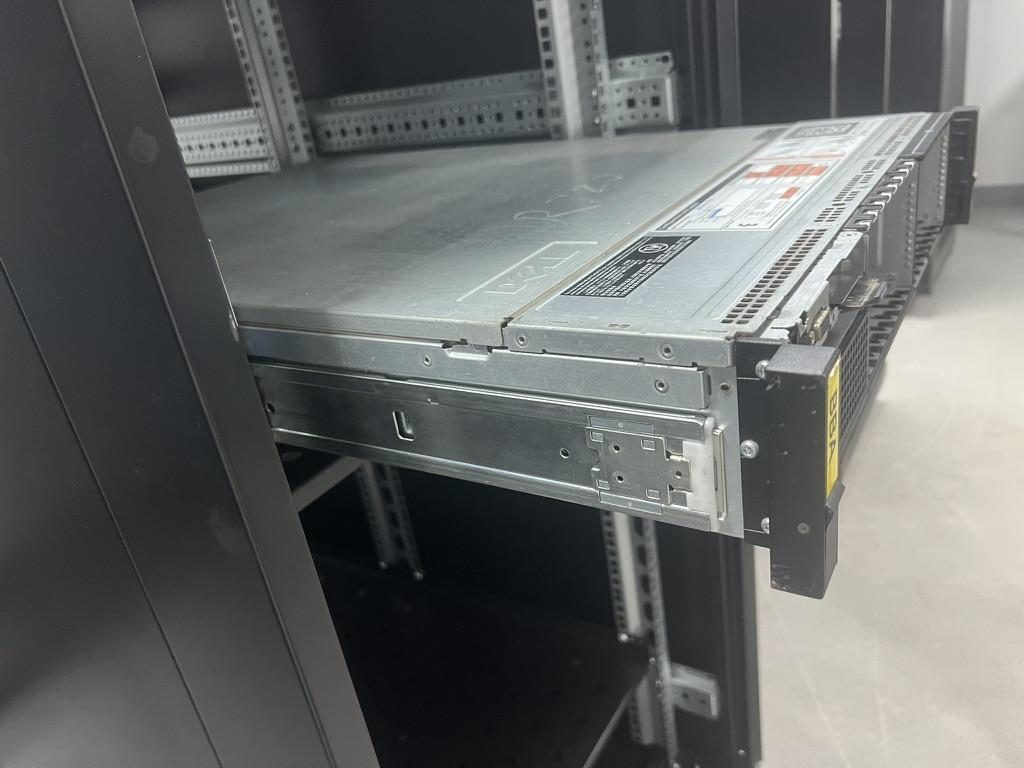
- Closed (retracted) length. The overall length of the rail with the inner member pushed in. Check the note for whether bracket ears are included. The inner member, which bolts to the chassis side, is usually close to this length, so the closed length must fit on the chassis side and clear whatever sits behind the rear post.
- Extension (travel). How far the inner member moves forward from closed to the stop. This decides whether the lid comes off in the rack.
- Fully extended length. Closed length plus travel. This is what has to fit in the aisle when a technician pulls the server out.
The relationship is simple: extended length = closed length + travel. The rest of this article is about picking values for the three inputs.
Step 1: measure the rack
Measure the inside distance between the front and rear mounting posts at the height where the server will sit, on both sides, and write down the smallest and largest value.
- Post-to-post distance, not cabinet depth. A 1,000 mm cabinet may have its posts set anywhere from roughly 600 to 900 mm apart. The rail only cares about the posts.
- Typical 4-post racks fall in the 600 to 900 mm band, but the spread is wide enough that you should always measure, especially in a mixed fleet.
- Measure from the rear post to the nearest obstruction behind it: door, vertical PDU, cable tray. This is your rear clearance budget.
- Record the hole type: square 9.5 mm, round, or threaded (M5, M6, 10-32 or 12-24 style). Hole type does not change the rail length, but it changes the bracket and the hardware. See rack hole types.
If the rack is already populated, measure at an empty position rather than trusting the datasheet; adjustable posts drift.
Step 2: measure the chassis
The chassis gives you two numbers that bound the rail length and one that bounds its thickness.
- Chassis depth from the front flange to the rear panel. This is the length the inner member has to fit on, and the reference for how much travel you need. Measure to the sheet-metal rear panel, then separately note anything that protrudes beyond it.
- Rear obstacles. Power supply handles, a folded cable management arm (CMA), rear I/O brackets and latches add to the chassis depth against the rear door, and can block the last few holes on the chassis side, shortening the usable inner-member length.
- Chassis width across the rail mounting surfaces, outside to outside. With the rack's inside width this gives the side gap.
- Side clearance between chassis and rack post. Half the difference between the rack's inside width and the chassis width, per side. This gap has to hold the stacked thickness of the rail (outer, middle and inner member) plus the bracket. A tight side gap rules out thick heavy-duty ball-bearing rails and pushes you toward a thinner friction profile, whatever travel you wanted.
Mark where the chassis-side holes are, or where holes could be added. A rail whose hole pattern lands on a PSU cutout is not the right length.
Step 3: decide the travel you need
Travel is a service decision, not a rack decision. Ask what the technician must do with the server while it is still on the rails.
- Full extension. The inner member travels far enough that the chassis clears the front posts, or nearly does, so the lid can be lifted off in the rack and every bay is reachable. This is the expectation for most 1U to 4U servers, and it needs a three-member ball-bearing rail, because a two-member rail cannot travel much beyond its own closed length without losing overlap.
- Partial or three-quarter extension. Roughly 60 to 75 percent of the chassis depth. Enough to reach fans, front-loaded drives and the front half of the board, not enough to pull the rear PSU bay clear. Acceptable when the rear is serviced from the back of the rack, or when the aisle is too narrow.
- Static (fixed) rails. No travel. The server is unbolted and lifted out for service. The normal choice for switches, shallow appliances and patch panels. See fixed rack rails.
The trade is straightforward. Longer travel costs closed length, thickness and money. A full-extension three-member rail needs enough overlap between members to carry the load at the end of the stroke, so its closed length is dictated by the travel and it is thicker than a friction rail. Friction rails are thinner and cheaper, but their travel is usually shorter and they are not meant for repeated in-rack service on heavy chassis. See ball-bearing vs friction for the mechanics, and confirm the rated dynamic load applies at full extension (load capacity explained).
Worked examples
These are generic arithmetic examples, not model specifications.
Example 1: 2U server, full extension, standard cabinet
Measured: post distance 740 mm, chassis 720 mm from front flange to rear panel, PSU handles protrude 30 mm, rear door 80 mm behind the rear post, side gap 12 mm per side.
- Bracket range: must include 740 mm. Ask for a range such as 650 to 950 mm so 740 sits well inside it.
- Closed length: the chassis side is 720 mm, but the last 20 mm is taken by a corner brace, so usable length is about 700 mm. Ask for 700 mm or less.
- Rear clearance: the PSU handles reach 720 + 30 = 750 mm behind the front post plane. The door is at 740 + 80 = 820 mm. That leaves 70 mm for cords and a folded CMA; check the CMA drawing.
- Travel: for full extension the rear of the chassis should clear the front post plane, so travel should be at least about 720 mm. Extended length is roughly 700 + 720 = 1,420 mm, and the aisle must hold that server plus a person.
- Side gap: ask the supplier to confirm the rail plus bracket fits 12 mm.
Example 2: 1U short-depth appliance, partial extension
Measured: post distance 600 mm, chassis 550 mm deep, no rear protrusions, side gap 9 mm per side, service limited to front fans and drives.
- Bracket range: must include 600 mm. Ask for a 550 to 750 mm band.
- Closed length: 550 mm minus a 20 mm rear zone gives 530 mm or less.
- Travel: three-quarter extension is about 0.75 x 550 = 410 mm. Extended length is roughly 530 + 410 = 940 mm.
- With short travel and a 9 mm gap, a two-member friction rail is the natural candidate; a three-member ball-bearing rail may not fit the gap.
Example 3: 4U GPU server, full extension, deep cabinet
Measured: post distance 900 mm, chassis 850 mm deep, PSU handles protrude 40 mm, rear post to door 120 mm, side gap 15 mm per side, loaded weight high enough to need a heavy-duty ball-bearing rail.
- Bracket range: must include 900 mm. Ask for a 700 to 1,000 mm band.
- Closed length: 850 minus a 20 mm rear zone gives 830 mm or less.
- Rear clearance: 850 + 40 = 890 mm behind the front post plane, against a door at 900 + 120 = 1,020 mm. That leaves 130 mm, comfortable for cords and a CMA.
- Travel: at least about 850 mm. Extended length is roughly 830 + 850 = 1,680 mm. Confirm the rated load applies at that extension; see heavy-duty rails for GPU and AI servers.
Reference table: rack post distance vs typical bracket range you should ask for
The bands below are ranges to request from a supplier, with roughly 20 to 30 mm of margin at each end. They are not product claims.
| Measured post-to-post distance | Bracket adjustment range to ask for |
|---|---|
| 570 to 730 mm | 550 to 750 mm |
| 620 to 830 mm | 600 to 850 mm |
| 670 to 930 mm | 650 to 950 mm |
| 720 to 980 mm | 700 to 1,000 mm |
If your fleet spans two bands, ask whether one bracket design can be offered in two lengths.
Common mistakes
- Measuring the cabinet's outside depth instead of the post distance. The rail spans the posts. A 1,200 mm cabinet says nothing about where its posts are.
- Forgetting the cable management arm. A CMA adds depth behind the chassis when closed and needs its own travel when the server comes out.
- Ignoring rear door clearance. The chassis, its PSU handles and the cords behind them all have to fit between the rear post and the door, and hinges or lock bodies often intrude further than the panel.
- Choosing a rail whose closed length is longer than the chassis. The inner member overhangs the rear of the server, and the mounting holes may land where there is no sheet metal.
- Mixing inches and millimeters. A 26-inch rail is about 660 mm; a 740 mm post distance is about 29.1 inches. Put every number in one unit first.
- Assuming one rail length fits every rack in the fleet. Two cabinets with the same nominal depth can have post distances that differ by more than 100 mm. Measure each rack model.
What to send a supplier
Rail length is easy to get right if the supplier has the numbers. Send:
- Post distance, minimum and maximum across the racks the rail must serve, and the hole type.
- Chassis depth from the front flange to the rear panel, plus the depth of any rear protrusions.
- Chassis width across the rail mounting surfaces and the side gap to the post.
- Required travel: full, partial with a target in mm, or static.
- Loaded weight, and whether a CMA will be fitted.
- A chassis or rack drawing if you have one. If it is under NDA, see sharing CAD with a rail manufacturer.
MetrixSlide returns a rail fitment proposal within 24 hours of receiving a chassis or rack drawing, reviewed by a mechanical engineer. Bracket range and rail length can be adjusted without a tooling fee within boundaries, along with hole patterns and thickness, so a bracket band between two standard ranges is normally a drawing change rather than a new tool. See what to send in a server rail RFQ and the server rail compatibility checklist, or go straight to the quote form.
FAQ
How long are server rails?
There is no single length. Closed length is set by the chassis depth the rail is built for, and bracket range by the post distances it must span. Most rails for 4-post racks cover somewhere between roughly 550 and 1,000 mm of bracket range, but the right number comes from measuring your rack and chassis.
Do rails need to match rack depth exactly?
No. Rails have an adjustable bracket range, and your post distance only needs to fall inside it with some margin. What does need to be close is the closed length against the chassis side: the inner member must fit without overhanging the rear.
What is rail travel?
Travel, or extension, is the distance the inner member moves forward from the closed position to the stop. Full-extension rails travel far enough for the chassis to clear the front posts so the lid can be removed in the rack. Partial-extension rails travel less, and static rails do not travel at all.
Can rails be too long?
Yes, in two ways. A closed length longer than the chassis side leaves the inner member overhanging with nowhere to mount. A closed length longer than the space between the front post and the rear obstruction leaves the rail hitting the door or PDU before the brackets reach the rear post.
Are King Slide rails a standard length?
No. OEM rail kits, including those King Slide makes for server brands, are sized per server model, and according to King Slide's website their server rails are sold through OEM programs rather than a published catalog with dimensions. Length is not published as a standard. Measure your rack and chassis and specify from those numbers.
Next step
Send your post distance, chassis depth and required travel through the quote form and MetrixSlide will return a fitment proposal within 24 hours. If you already know you need a sliding rail with full extension, start from the sliding rack rails range and note the length adjustments you need in the request.
King Slide is a trademark of King Slide Works Co., Ltd. Dell and PowerEdge are trademarks of Dell Inc. HPE and ProLiant are trademarks of Hewlett Packard Enterprise. Other brand names are the property of their respective owners and are used only to describe compatibility or comparison. MetrixSlide is not affiliated with, endorsed by, or sponsored by these companies.