

Square hole racks are the default in modern data centers, and most tool-less server rails are designed around them. But "square hole" only tells you the shape of the opening. Whether a rail kit actually fits depends on the hole size, the vertical pitch, the post thickness and the bracket style on the rail. This guide covers what the EIA-310-D square hole is, how tool-less pegs and cage nuts use it, and what to check before you order server rack rails for a square hole rack.
What a square hole rack is under EIA-310-D
EIA-310-D is the standard behind the 19-inch rack. It fixes the width between the mounting flanges, the 1U increment of 44.45 mm (1.75 in) and the hole pattern on the vertical posts. Within each U the three holes are spaced 15.875 mm, 15.875 mm and 12.7 mm apart, which is why a rail bracket has to land on a specific hole in the group and not just "any hole".
The standard allows several hole styles on the post, and the square hole is the one that has taken over in server racks. The nominal square opening is 9.5 mm (0.375 in), punched into the post flange. It is not threaded and has no fixed fastener of its own. That is the point: a square hole accepts either a tool-less peg from the rail bracket or a cage nut clipped in from the front, so the same rack works with both mounting styles.
Round unthreaded holes and threaded holes (M5, M6, 10-32 and 12-24 style) sit in the same pitch pattern but need different hardware. The rack hole types guide explains how to identify each, and the 19-inch rack standard post covers the EIA-310 and IEC 60297 background. MetrixSlide rails are designed to EIA-310-D and IEC 60297-3-100/-105, and standard models support square 9.5 mm, round and threaded posts.

Tool-less peg and hook brackets
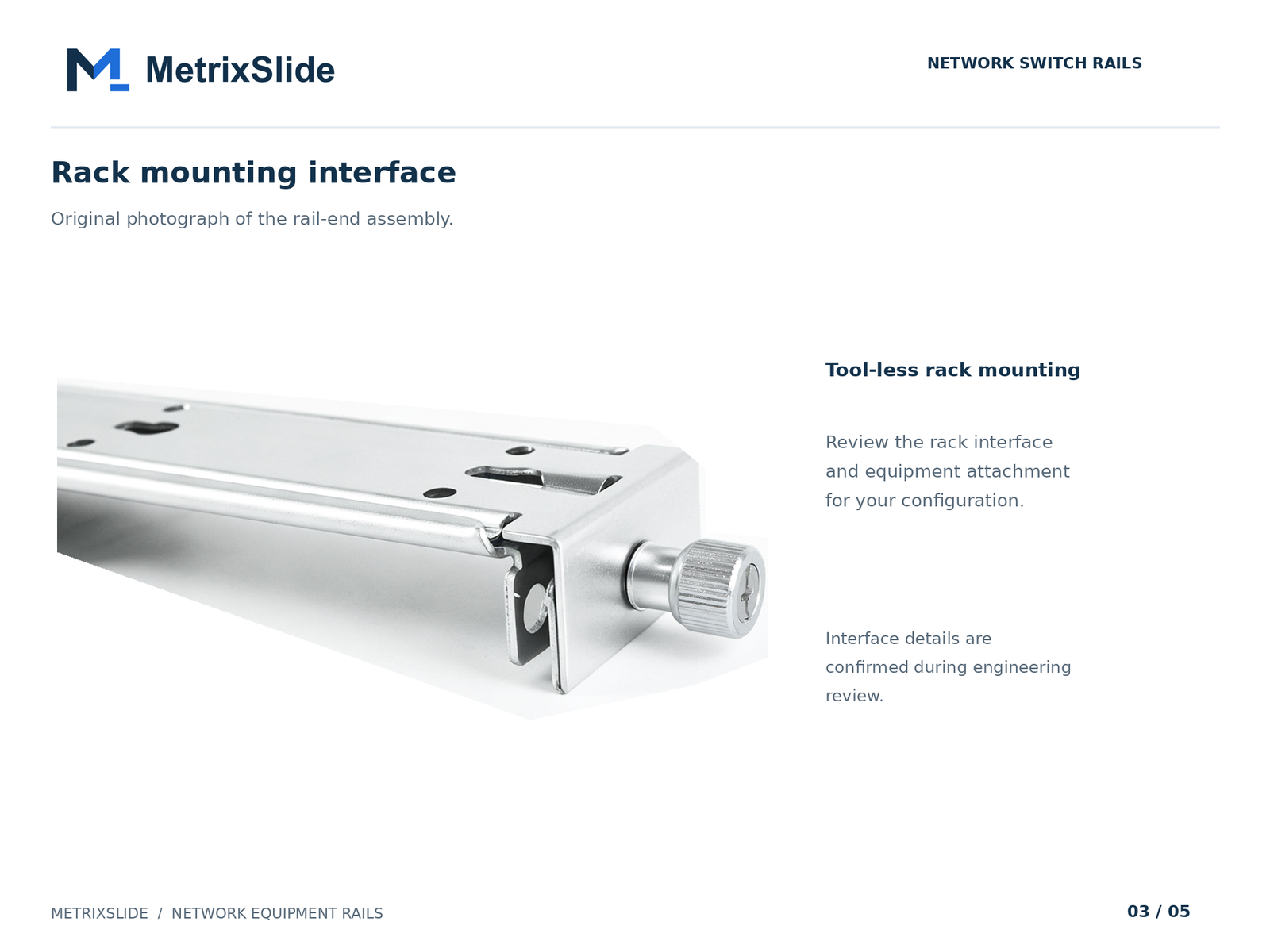
A tool-less rail bracket has two or three pegs (sometimes hooks or spring pins) sized to pass through the 9.5 mm square hole. You align the pegs with the holes, push the bracket onto the post and a spring latch or slide locks it so the pegs cannot back out. No screws, no cage nuts, no tools, and a single person can do all four corners in a minute.
Three things make this work:
- Peg geometry. The peg shoulder is wider than the hole so it seats against the post flange, and the pin section is close to 9.5 mm so the rail cannot shift up or down. A peg made for round holes (which are smaller) will rattle in a square hole.
- Latch travel. After the pegs pass through, the latch has to close against the back of the post. Too thick a post and the latch will not close; too thin and the bracket has play.
- Bracket range. The rear bracket slides along the outer member to suit the front-to-rear post spacing. That adjustable range is on the rail spec sheet and is the number to compare with your rack, not the rack's nominal depth.
MetrixSlide's MS-TLS-120 ball-bearing kit and MS-FMR-1U2U-115 friction rail are both tool-less kits of this type for square hole racks. The tool-less vs screw-mount comparison covers when the tool-less style is worth specifying.
Video: third-party installation guide
Cage nuts for screw-mount rails
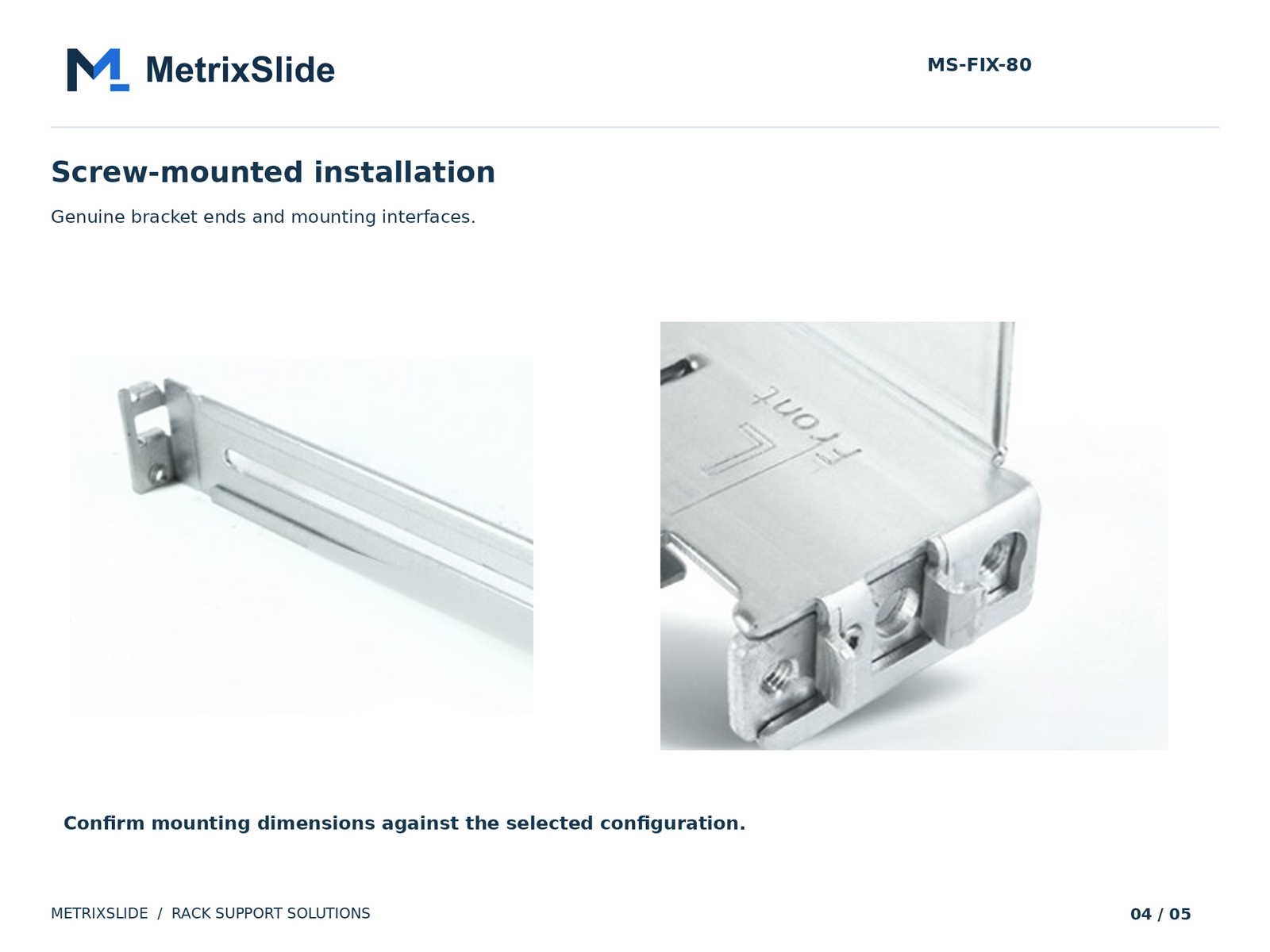
If the rail has a screw-mount bracket, the square hole still works, but it needs a cage nut first. A cage nut is a square nut held in a spring steel clip. You squeeze the clip, push it into the square hole from the front or back of the post, and the clip springs open to hold the nut behind the flange. The bracket then bolts to that nut with a matching screw, usually M6 or 12-24 (10-32 and M5 cage nuts also exist).
Practical points:
- Thread must match the screw. M6 and 12-24 look similar and cross-thread easily. Buy cage nuts and screws as a set.
- Cage nuts are made for a panel thickness range. The clip has to snap around the post flange; check the nut's stated range against your post gauge.
- Install nuts before rails. Put all cage nuts in at the right U positions first, then hang the rail. A cage nut tool or a flat screwdriver makes removal far easier than fingers.
Screw-mount brackets take longer to install but are the usual choice on round-hole and threaded racks, and on heavy rails where the buyer wants a positive bolted joint. The installation guide walks through the sequence for both styles.
Square vs round vs threaded: which bracket
| Rack hole type | Typical opening | Hardware needed | Tool-less bracket works? | Screw-mount bracket works? |
|---|---|---|---|---|
| Square, 9.5 mm (EIA-310-D) | 9.5 mm square, unthreaded | None for tool-less pegs; cage nut plus screw for screw-mount | Yes, with square-hole pegs | Yes, with cage nuts |
| Round, unthreaded | Round, smaller than 9.5 mm | Clip nut or round-hole peg adapter | Yes, if the kit includes round-hole pins or adapters | Yes, with clip nuts |
| Threaded (M5, M6, 10-32, 12-24) | Round, tapped | Screws of the matching thread | Usually no; some kits include a threaded-rack adapter | Yes, screw directly into the post |
Two rules follow from the table. A square hole rack is the most flexible, because it accepts tool-less pegs and cage nuts. A threaded rack is the least flexible, because the thread is fixed at the factory and the rail bracket must be drilled or slotted to match.
Converting between square, round and threaded
You cannot change the holes in a rack post, but you can change what the rail sees:
- Square to screw-mount: add cage nuts, as above. This is the everyday conversion.
- Round to tool-less: some tool-less kits ship with a second set of pins sized for round holes, or a small adapter plate; if the kit does not, use clip nuts and a screw-mount bracket instead.
- Threaded to tool-less: rarely practical. A few OEM kits include a threaded-rack adapter, but the reliable answer is a screw-mount bracket with slots that accept the rack's thread size.
- Any type to any rail: MetrixSlide can change the bracket on a standard rail to suit your post, with no tooling fee within our customization boundaries. Send the rack drawing and the fitment proposal will state which bracket applies.
The rack hole types post has photos of each style if you are identifying a rack from a distance.
What to check before ordering
Rack hole shape is only one line on the checklist. Confirm these on the rack drawing or with a tape measure:
- Hole size. Confirm the square opening is 9.5 mm. Some older or telecom racks use square holes with different dimensions, and a 9.5 mm peg will not seat correctly.
- Hole pitch. Verify the 15.875 / 15.875 / 12.7 mm pattern and that the front and rear posts are on the same U alignment. Rails need front and rear pegs in matching holes.
- Post thickness. Both tool-less latches and cage nuts assume a flange thickness range. Thick-gauge industrial racks and thin-gauge budget racks both cause problems.
- Flange orientation. Rails assume the mounting flange faces inward toward the equipment. Some open-frame racks have flanges facing outward or a second flange that blocks the latch.
- Front-to-rear post spacing. Compare it with the rail's bracket adjustment range; see rack mounting depth vs rack depth vs chassis depth.
- Door and side clearance. The latch on the bracket needs finger room, and rails add width outside the chassis. The server chassis dimensions post covers the chassis side of the fit.
Common mistakes with square hole rack rails
- Assuming square means tool-less. A screw-mount rail on a square hole rack still needs cage nuts. Order them with the rail.
- Mixing M6 and 12-24. The threads cross easily. Label the hardware bag by rack.
- Pegs in the wrong hole of the U group. The three holes in a U are not evenly spaced. Mount the bracket in the holes the rail drawing calls out, or the server ends up straddling two U positions.
- Front and rear brackets one hole apart. The rail sits at an angle, the ball retainers bind and the server does not slide. Count holes from the same reference on both posts.
- Ignoring post thickness. A latch that will not close is not "stiff"; it is the wrong bracket for the post.
- Ordering by rack brand. Two racks from the same brand can have different hole types. Check the specific model and confirm on site.
FAQ
What size is the square hole in a server rack?
Under EIA-310-D the nominal square hole is 9.5 mm (0.375 in). The holes follow the standard U pitch of 44.45 mm with spacing of 15.875, 15.875 and 12.7 mm inside each U, so a bracket must land on the correct hole in the group.
Do tool-less server rails need cage nuts?
No. Tool-less brackets use pegs or hooks that pass through the square hole and lock with a latch, so no cage nuts or screws are needed. Cage nuts are only required when a screw-mount rail bracket is used on a square hole rack.
Can I use square hole rails on a round hole rack?
Only if the kit provides round-hole pins or an adapter, because round holes are smaller than the 9.5 mm square opening and standard square-hole pegs will not seat correctly. Otherwise use a screw-mount bracket with clip nuts, or ask for a bracket change.
Which thread do cage nuts use?
The common sizes are M6 and 12-24, with 10-32 and M5 also available. The screw must match the nut exactly, since M6 and 12-24 are close enough to cross-thread. Buy nuts and screws as a matched set for each rack.
Are MetrixSlide rails made for square hole racks?
Yes. Standard models such as the MS-TLS-120 and MS-FMR-1U2U-115 are tool-less kits for 9.5 mm square hole racks, and MetrixSlide also supplies round and threaded (M5, M6, 10-32, 12-24 style) brackets. A different bracket on a standard rail is a flexible change with no tooling fee.
Next step
If your racks are square hole and you want a rail that clicks in without hardware, start with the MS-TLS-120 tool-less ball-bearing kit or browse the sliding rack rails category. For mixed racks, or a post that does not match the table above, send the rack drawing and your chassis details through the quote page. A mechanical engineer returns a fitment proposal within 24 hours, and standard models ship in 3 business days with an MOQ of one pair, so you can order a sample pair and confirm the fit on your own posts.
King Slide is a trademark of King Slide Works Co., Ltd. Dell and PowerEdge are trademarks of Dell Inc. HPE and ProLiant are trademarks of Hewlett Packard Enterprise. Other brand names are the property of their respective owners and are used only to describe compatibility or comparison. MetrixSlide is not affiliated with, endorsed by, or sponsored by these companies.