
Sometimes, yes—but only within a documented rail system. A single inner rail is plausible when the mating members are installed and sound, the chassis mounts and latches are intact, the rail family and interface can be identified, and the replacement is checked against that system. Inner rail can mean different member designs, so this is not a universal compatibility call.
Start With the Rail System You Actually Have
Inner, Middle, and Outer Rails: What Each Part Does
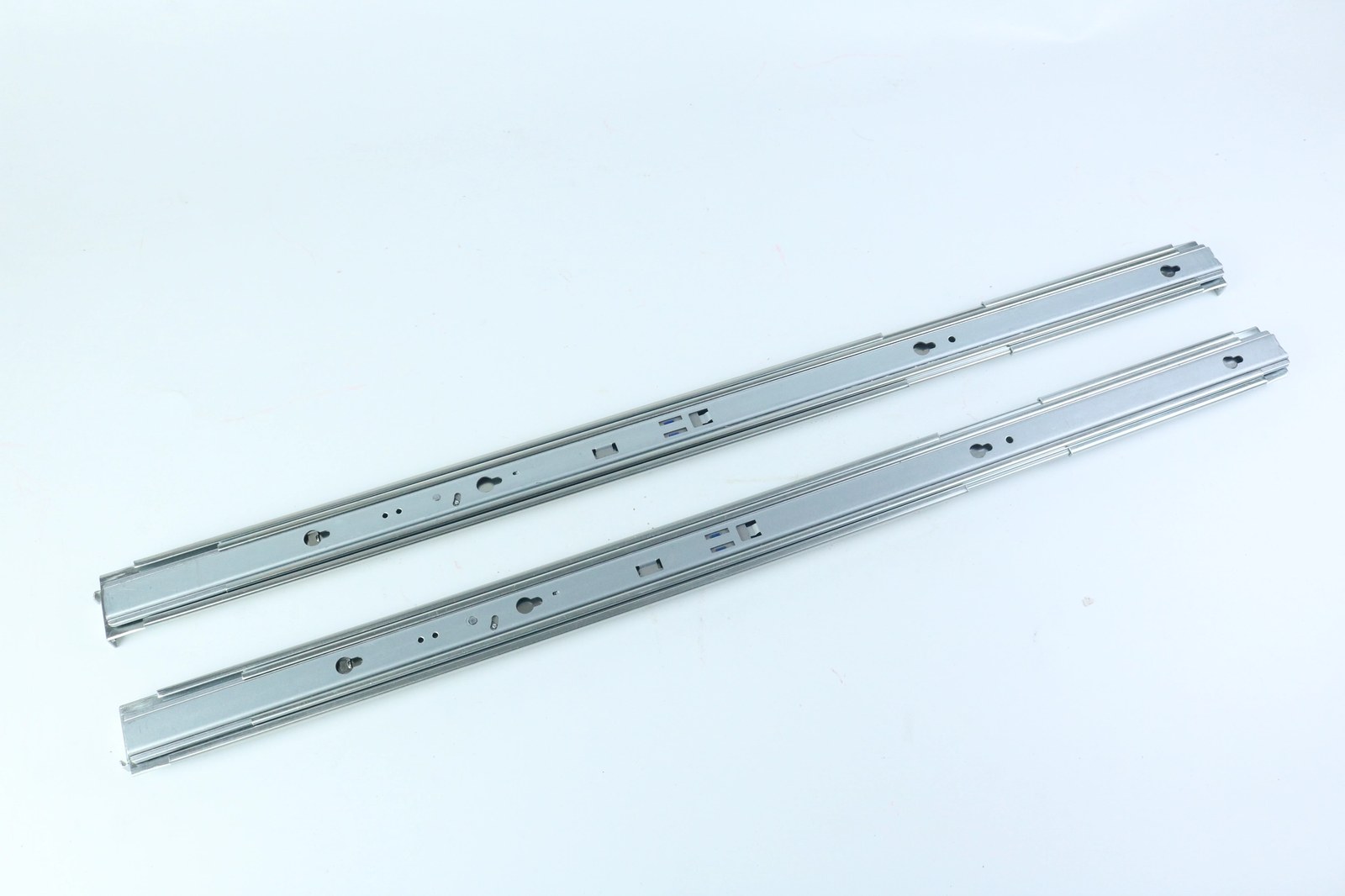
In a common three-member ball-bearing slide, the outer rail mounts to the rack, the inner rail attaches to the chassis, and the middle member carries extension travel. Some kits use fewer members or different latches; confirm the arrangement in the exact rail-kit manual. For broader interface evidence, see our guide to server rail compatibility for Dell and HPE systems.
When a Single Inner-Rail Replacement Is Plausible
- The outer rail pair is installed, straight, complete, and from the same documented family.
- The member interface is known from a manual, drawing, or manufacturer confirmation, not inferred from a photo.
- Chassis brackets, screw holes, and latch features are intact.
- The replacement is a documented service member or an alternative accepted after interface and fit review.
- The intended load, extension, and operating condition fit the stated rail configuration.
When to Replace the Full Kit or Request an Interface Review
- An outer or middle member is missing, bent, worn, or unidentified.
- Labels are gone, members are mixed, or no manual or drawing is available.
- Chassis mounts are cracked or elongated, or a latch is broken.
- Fitting would require drilling, welding, cutting, lengthening, or defeating a latch.
- The load or extension requirement is unclear.
- The only evidence is the server or rack brand.
In those cases, a complete kit or interface review is usually safer. Brand similarity is not an interface specification.
Build a Matching Dossier for a Replacement Inner Rail
Build the dossier before shopping. The goal is to prove four things: what the chassis needs, what the existing rack-side member provides, how the members engage, and what the installed system must carry.
What to Photograph and Measure on the Chassis and Existing Outer Rail
| What to capture | Why it matters | Useful evidence | What it does not prove |
|---|---|---|---|
| Chassis interface | Left and right mounts, front and rear brackets, latch cutouts, orientation | Photos with scale, manual diagram, measured hole pattern | A photo does not prove latch or load fit |
| Existing members | Member count, profile, travel type, labels, latch details | Wide and close-up photos, full label text, manual | Partial label or matching color is not a geometry spec |
| Length and envelope | Member length, mounting datum, closed and open position | Measurements to the rail maker's datum | A reading without a stated datum can mislead |
| Rack interface | Square or threaded holes, post spacing, holes used, front and rear position | Rack photos, hole type, applicable spacing standard, rail instructions | 19 in / 482.6 mm nominal width is not a compatibility proof |
| Fasteners | M6, #10-32, #12-24, or square-hole pegs and clips | Hole photos, known mating hardware, manual | A loose fit is not thread confirmation |
| Load and travel | Equipment weight, required extension, static or dynamic use, environment | Exact model rating for the stated configuration | U height does not determine capacity |
Measure to the rail manufacturer's datums. Rack cabinet depth, mounting-post distance, closed rail envelope, and chassis depth are distinct; substituting one for another can produce a rail that looks close but cannot close or reach. 19 in / 482.6 mm is a nominal panel-width classification, not chassis-body width. 1U is 44.45 mm, and mounting-hole column spacing is commonly about 465.1 mm subject to the standard and tolerances. If you record vertical hole patterns, distinguish the repeating 5/8, 5/8, 1/2 inch intervals from hole diameter.
How to Read Labels, Manuals, and Documented Part Numbers
Thread labels need care. M6, #10-32, and #12-24 are different systems; M6 coarse pitch is 1.0 mm, #10-32 has 32 threads per inch, and #12-24 has 24. Do not confuse #6-32 with M6. Threaded holes already contain their thread; square holes use the hardware or peg arrangement specified by the actual kit and do not always need cage nuts.
Record labels exactly and use the server or rail-kit manual for documented part numbers. A service tag or model name may identify the platform, but it does not by itself prove a purchasable inner rail. Do not decode a proprietary prefix from appearance.
Which Details Require NDA or CAD-Level Review
If the only identifier is a private drawing, factory mapping, or customer-specific interface data, move to NDA and project CAD review before sharing or relying on it. Public photos and labels alone cannot substitute for controlled interface data.
Single Inner Rails, Full Rail Kits, or Custom Rail Support: Compare the Real Options
Use the dossier to compare sourcing routes by evidence and limits, not by brand similarity.
OEM, Third-Party, and Salvage Rails: Evidence and Limits
| Sourcing route | What it can solve | Evidence needed | Limits |
|---|---|---|---|
| OEM single member | A documented service part for the exact rail kit | Exact kit identity, manual or drawing, chassis interface | A server model alone may not resolve to a purchasable part; availability is not assumed |
| Third-party member | A possible alternative when the interface is reviewable | Member geometry, latch, travel, load application, fit review | Similar length or a same-brand rack is not enough |
| Salvage member | A candidate for obsolete equipment when condition is known | Full label, inspection for bends, wear, missing latches, mixed members | Treat as a trial-fit candidate, not a drop-in equivalent |
| Complete rail kit | A complete documented starting point when members are missing or mixed; chassis-mount damage requires separate assessment and repair | Chassis and rack match, kit instructions, stated load configuration | The kit still has to match both chassis and rack |
| Custom rail support | Standard length, bracket, mounting direction, or travel does not fit | Interface review, requirements, CAD, sample, physical fit, validation | Work is staged; passing one stage does not establish another |
| Fixed support bracket | A different complete support approach when sliding access is not required | Product-specific mounting and stated support configuration | Not an inner-rail repair and does not restore slide travel |
For a documented service part, the exact rail-kit identity matters more than the server model alone. Third-party and salvage members are candidates for review and trial fit, not drop-in equivalents.
When Custom Length, Bracket, or Mounting Direction Is the Better Fit
Custom support is relevant when standard length, bracket, mounting direction, or travel does not fit. MetrixSlide reviews rack-side and chassis-side interfaces and develops custom rail length, bracket, mounting, and travel configurations. Work is staged: requirements, CAD, sample, physical fit, performance validation. Passing one stage does not establish another.
What MetrixSlide Can Review Before Sample Development
We can support project CAD, installation guidance, and sample development. We do not promise universal OEM interchangeability, brand authorization, loose inner-rail inventory for every kit, or general onsite repair.
Fixed Support Is a Different Solution
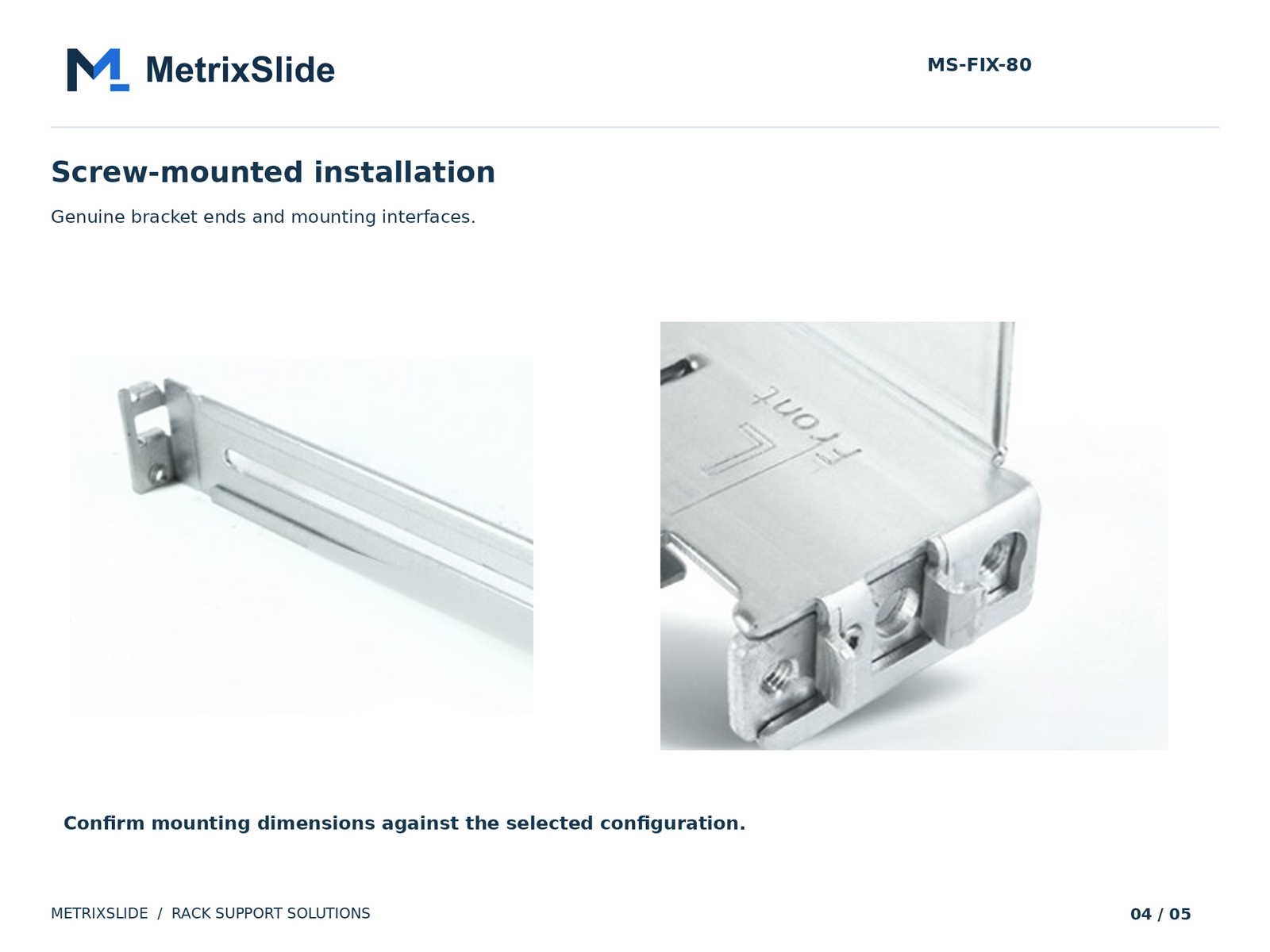
A fixed rack-support bracket is a different complete support approach, not a repair part for a missing inner rail. It can be relevant when sliding service access is not required, but it does not restore slide travel or prove chassis interface compatibility. The reference image below shows a fixed bottom-support structure for a specific product, not an OEM rail interface.
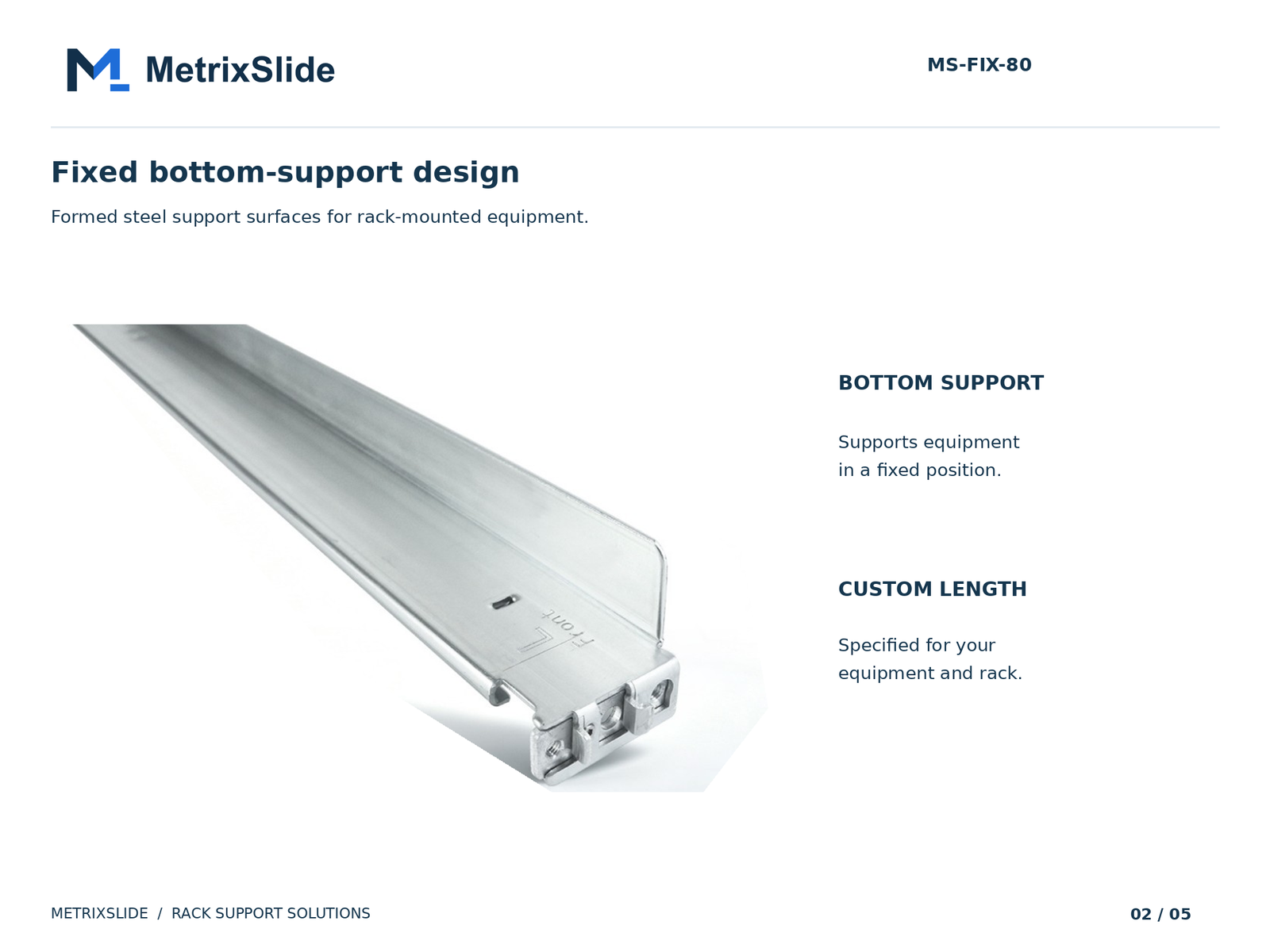
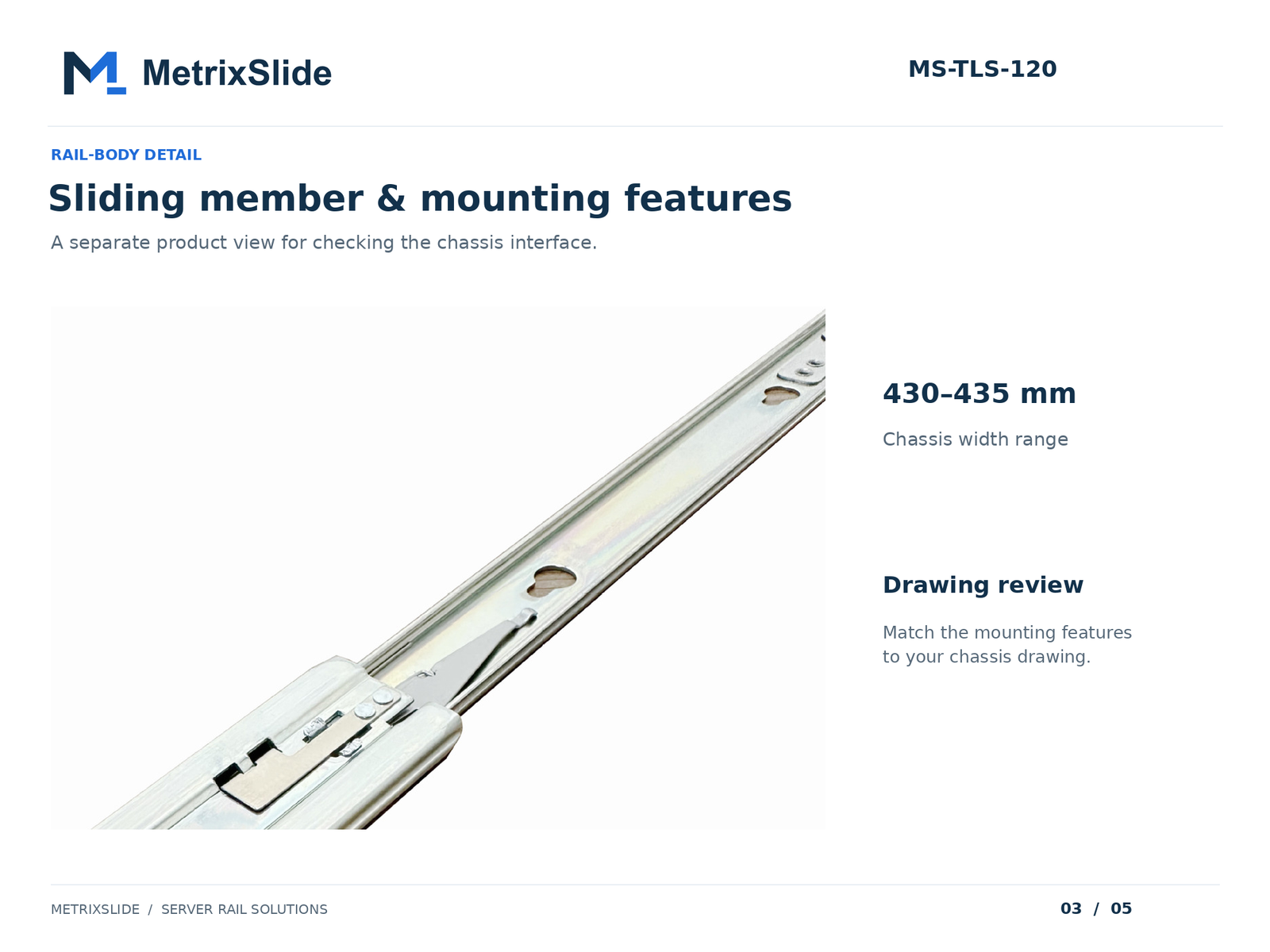
Product examples include the MS-TLS-120 tool-less ball-bearing server rail for a slide-based approach and the MS-FIX-80 fixed rack-support bracket for a fixed-support approach. Each remains specific to its own product range and mounting configuration.
Installation and Fit Checks for Replacement Inner Rails
Use the exact server or rail-kit manual for isolation, chassis removal, latch release, fastener hardware, lubrication, and torque. This section is a check sequence, not a substitute for those instructions.
Pre-Installation Checks for Chassis, Outer Rails, and Rack
- Record the rack U position and inspect the outer rails for bends, loose mounting, and damaged latches.
- Confirm left and right replacement members and front-to-rear orientation.
- Inspect chassis brackets, screw holes, and latch points. Do not install onto cracked or elongated mounts.
- Match the rack hole type and hardware to the rail instructions. Do not force a #10-32 fastener into an M6 hole or use a square-hole peg without the specified arrangement.
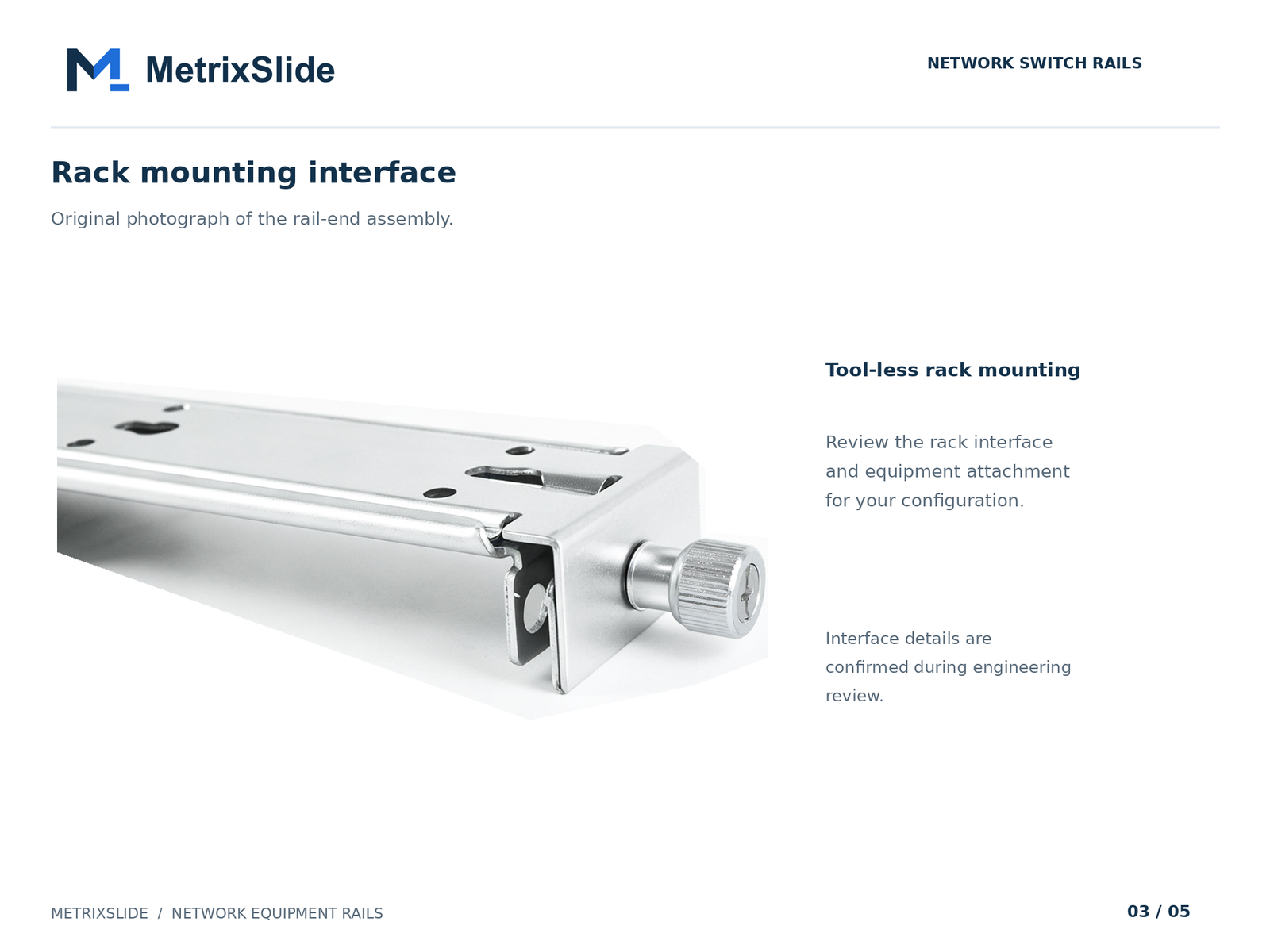
- Separate tool-less rack attachment from tool-less chassis attachment. One does not prove the other.
Trial-Fit Checks for Alignment, Latch Engagement, and Travel
Support the chassis only as the manual requires. Check member engagement, latch feedback, full travel, and the closed envelope without forcing parts. Confirm that every intended fastener or latch point engages, not just the front panel. A rail that needs lifting, twisting, or a partial latch to close is not a successful fit.
What to Escalate Instead of Drilling, Welding, or Forcing Parts
Stop if you need to drill, weld, cut, lengthen, bend, or defeat a latch; if threads do not match; if the rail binds at a specific travel position; or if chassis mounts are damaged. Record which side, which member, the travel position, the latch behavior, and the exact hole or fastener type. That record is more useful than a general does-not-fit photo.
Load, Temporary Mounting, and Stop Conditions When Rails Are Missing
A missing inner rail changes the support path, not just the parts list. Do not treat front-panel fasteners, a single rail, or an unconfirmed shelf as permanent support.
Why Rail Load Ratings Are System- and Condition-Specific
Load ratings belong to the stated rail model and configuration, whether expressed per rail or per pair, and depend on extension and static or dynamic conditions. Do not add pair ratings to create a combined assembly rating, divide rack weight by rail count, or assume each side carries exactly half. Chassis height alone does not establish capacity.
Temporary Maintenance Support vs. Permanent Rack Operation
If temporary maintenance support is necessary, use a method the equipment maker permits. If a tray or shelf is considered, verify the permitted mounting method, the support's stated rating, rack connection, airflow, and service access. Temporary support is not equivalent to an engineered rail system and should not become permanent operation without approval.
When to Stop and Request an Engineering Review
Stop before continued use when no documented support or rating exists, a latch will not engage, the rail binds, members are from different families, chassis mounts are damaged, or modification is needed. Move to an engineering review rather than testing the installation with production equipment.
FAQ
Can I replace only the inner rails if the outer rails are still installed?
Only if the outer rails are present, undamaged, and identifiable as the same documented system, and the chassis interface is confirmed. The replacement must match member geometry, latch, travel, and load application—not just the server brand. Trial fit and the stated load configuration are still required.
How do I confirm that a replacement inner rail matches my chassis and outer rail?
Record chassis mounts, existing member labels and profile, rail length and datum, rack hole type, and load or travel requirement. Compare them with the replacement drawing or manual, then trial-fit per the rail-kit instructions. Photos alone or a same-brand claim do not confirm compatibility.
Do I need the exact OEM rail-kit manual for brand-specific installation steps?
Yes, for isolation, chassis removal, latch release, fastener hardware, lubrication, and torque. This article gives checks, not an OEM procedure. If the manual is unavailable, ask the equipment or rail-kit manufacturer rather than inferring the step.
Are third-party or used inner rails guaranteed to be interchangeable?
No. A third-party or salvage member may be a candidate only after its interface, geometry, latch, travel, condition, and load application are confirmed. Used rails can have wear or hidden damage, and appearance is not a guarantee. Treat them as candidates for review and trial fit, not drop-in equivalents.
Can a server be operated temporarily without rails?
Not on an unconfirmed support path such as front-panel fasteners or a single rail. If temporary maintenance support is necessary, use a method the equipment maker permits and verify the support's stated configuration, rack connection, airflow, and service access. Temporary support does not create a permanent rail rating.
Does a taller chassis automatically require a different rail load rating?
No. Capacity belongs to the specific rail model, mounting configuration, extension, and static or dynamic condition, not to U height alone. A taller chassis may change weight or balance, so use the stated rating for the actual assembly.
When is replacing the complete rail kit more appropriate than sourcing an inner rail?
When outer rails are missing, bent, or unidentified, members have been mixed, or chassis mounts and latches are damaged. Damaged chassis mounts must be assessed and repaired through the equipment maker before any rail kit is installed. A complete documented kit still has to match the chassis and rack. If no standard kit fits, move to an interface review rather than modifying parts.
Request a Non-Confidential Application Review
Send non-confidential basics first: server model, rack depth, hole type, rail length, mounting direction, estimated load, and photos of the chassis and existing outer rail. Request a non-confidential interface review. If proprietary drawings or interface data are needed later, we can work under an appropriate NDA through engineering confidentiality.