
Working with an OEM Server Rail Manufacturer: How a Rail Project Actually Runs
A practical, step-by-step guide to the OEM server rail manufacturer process — from initial requirements to design freeze, CAD, samples and validation.
How to Shortlist OEM Server Rail Manufacturers (Supplier Comparison Checklist)
Sourcing rails for U.S. deployments starts with a repeatable shortlist process that separates real OEM capability from catalogue-sellers. For engineers and procurement teams, treat supplier selection as an evidence-driven audit: capacity, policy, transparency and proof-of-process matter as much as product fit.
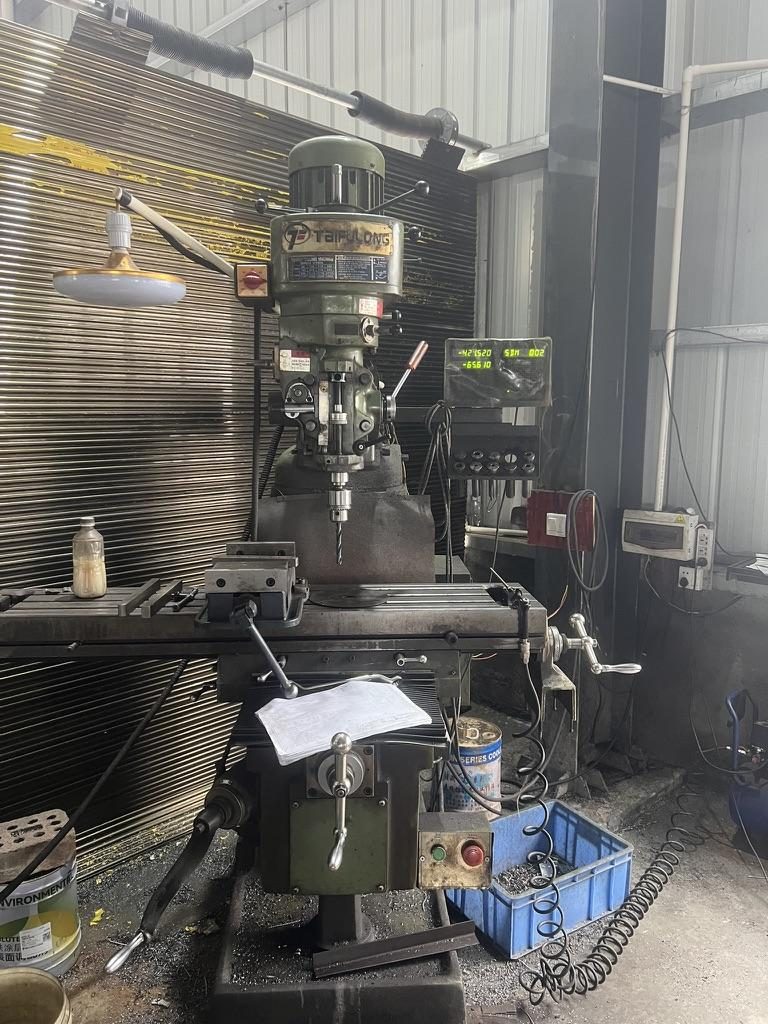
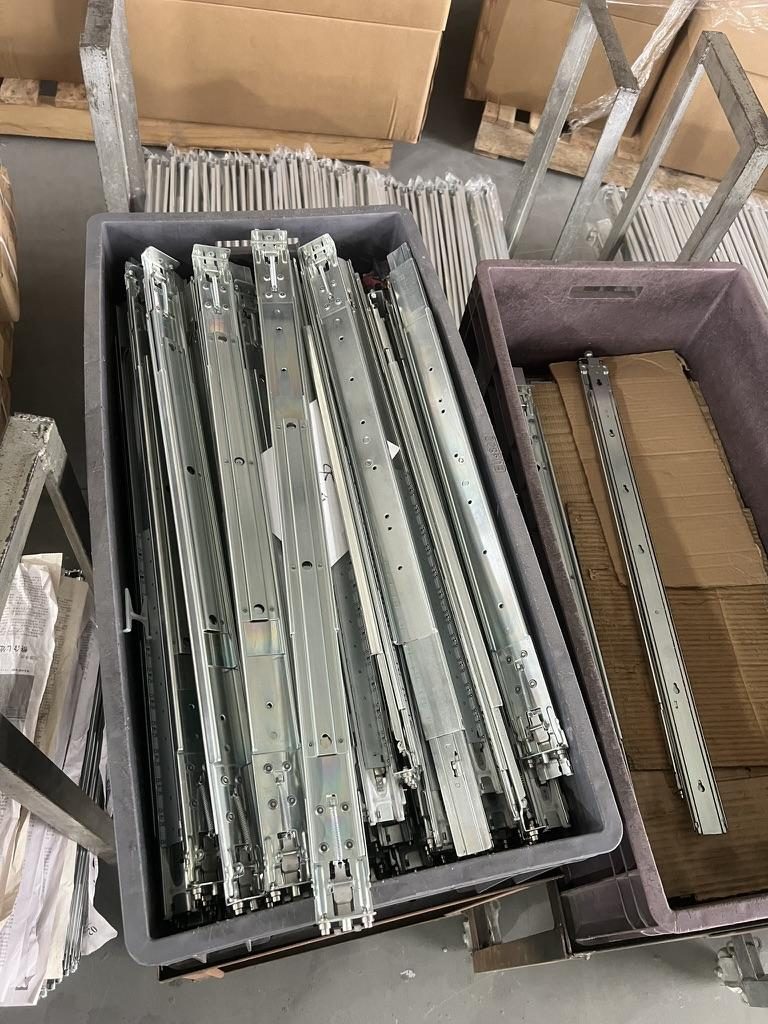
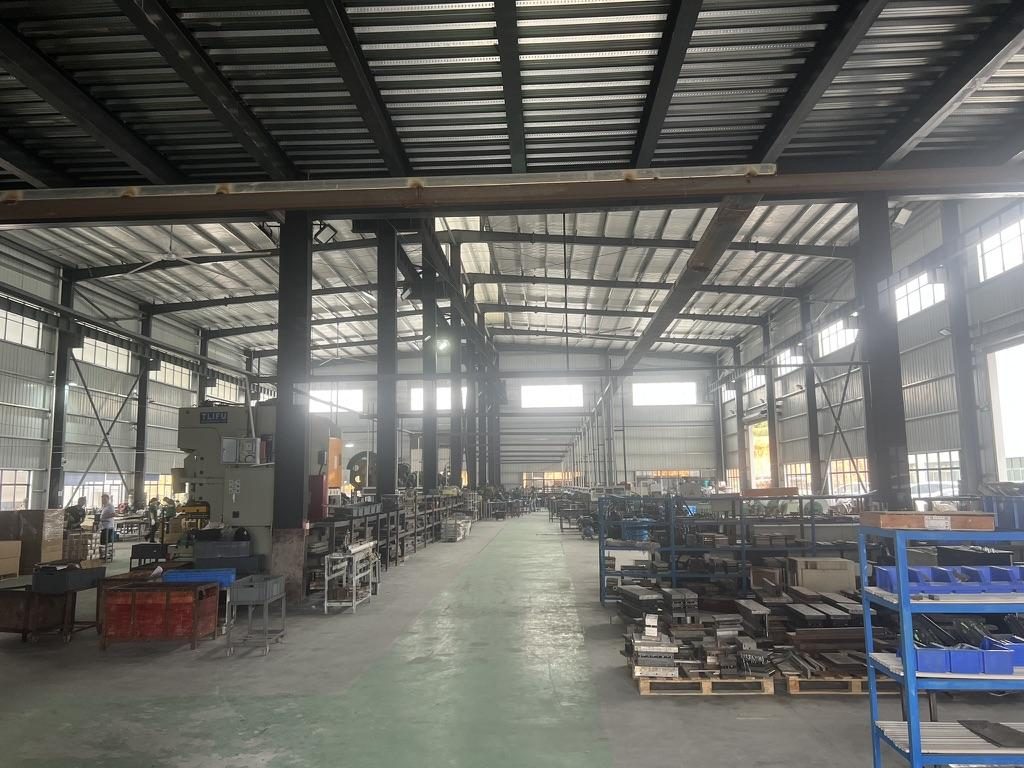 Overview of the server rail production workshop
Key, quantifiable screening fields to request up front
- Recent shipment volume or monthly output ranges (pairs/month or pairs/quarter) — ask for recent data rather than a marketing claim.
- Sample policy and sample lead time — in MetrixSlide engineering practice, sample production for small engineering batches has been delivered in the mid-teens of calendar days (≈15–20 days) after order/drawing confirmation in several cases; always confirm per-project.
- Shortest production lead time band and whether it shifts with seasonality (Q4 demand spikes are common in the industry).
- MOQ rules for stocked vs custom items (ask for both per-SKU and per-tooling).
- Quotation model: per-pair price, price breaks, whether bespoke bracket/hole-pattern/length changes are considered bounded customizations or structural changes that attract NRE/tooling.
- Payment terms and accepted Incoterms (EXW/FOB/DDP) and whether the supplier offers U.S. warehousing or DDP options.
- Certifications and management-system evidence — request certificate scans and the scope statement that explicitly covers “processing of metal products (slides)” or equivalent; ask for RoHS/REACH statements and any product declarations relevant to your market.
- Factory-visibility evidence: recent factory photos, tooling/die-room photos, and a live virtual walkthrough or third‑party audit summaries where available.
- Customer references or anonymized case studies (e.g., “a North American telecom OEM, engineering engagement for a 1U friction rail”).
- Published load baselines and the exact test definition: load per pair vs per rail, static vs dynamic, extension state and fixture description (if a baseline model is cited).
Supplier comparison table
| Field | Supplier A | Supplier B | Supplier C |
|---|---|---|---|
| Annual capacity (pairs/year) | |||
| Sample lead time (days) | |||
| Shortest production lead time | |||
| MOQ (stock/custom) | |||
| Quotation model (unit / breaks / NRE) | |||
| Payment & incoterms | |||
| ISO 9001:2015 (yes/no) | |||
| Test reports available (load/life) | |||
| Factory photos / virtual tour | |||
| Customer references / case studies | |||
| Local warehousing / DDP option (US) |
How to verify supplier credibility (practical checks)
-
Demand factory photos of the workshop, press lines and tooling storage; request a live virtual walkthrough. MetrixSlide can and does document roll‑forming, press‑forming and packing areas for buyer review when available.
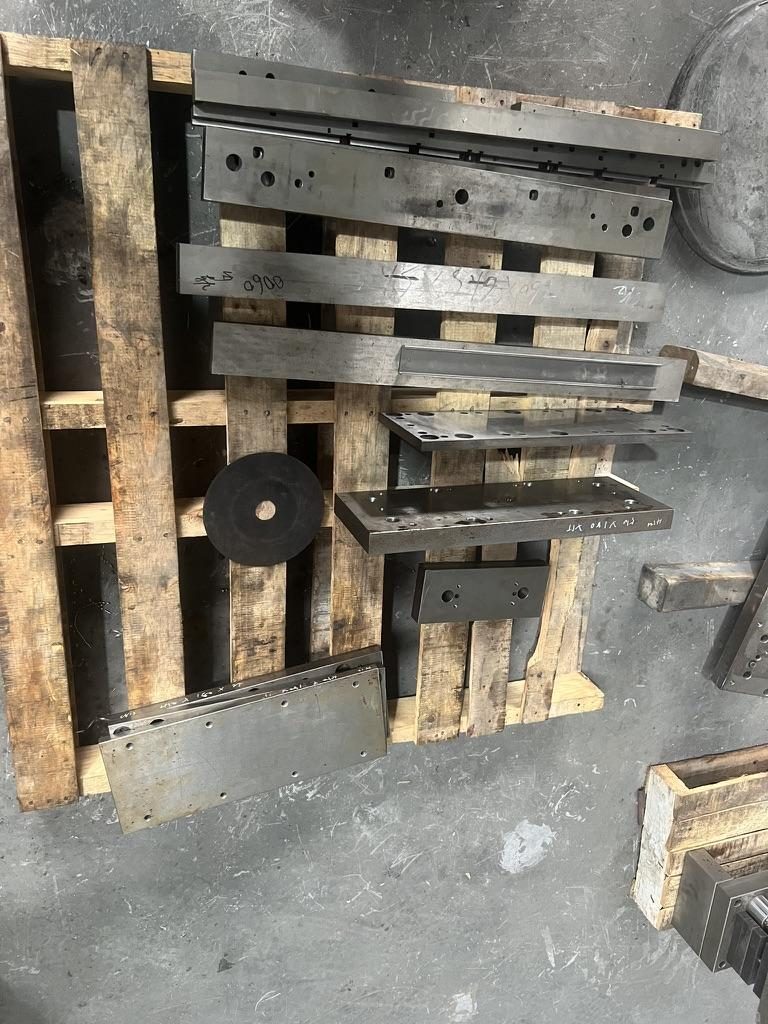
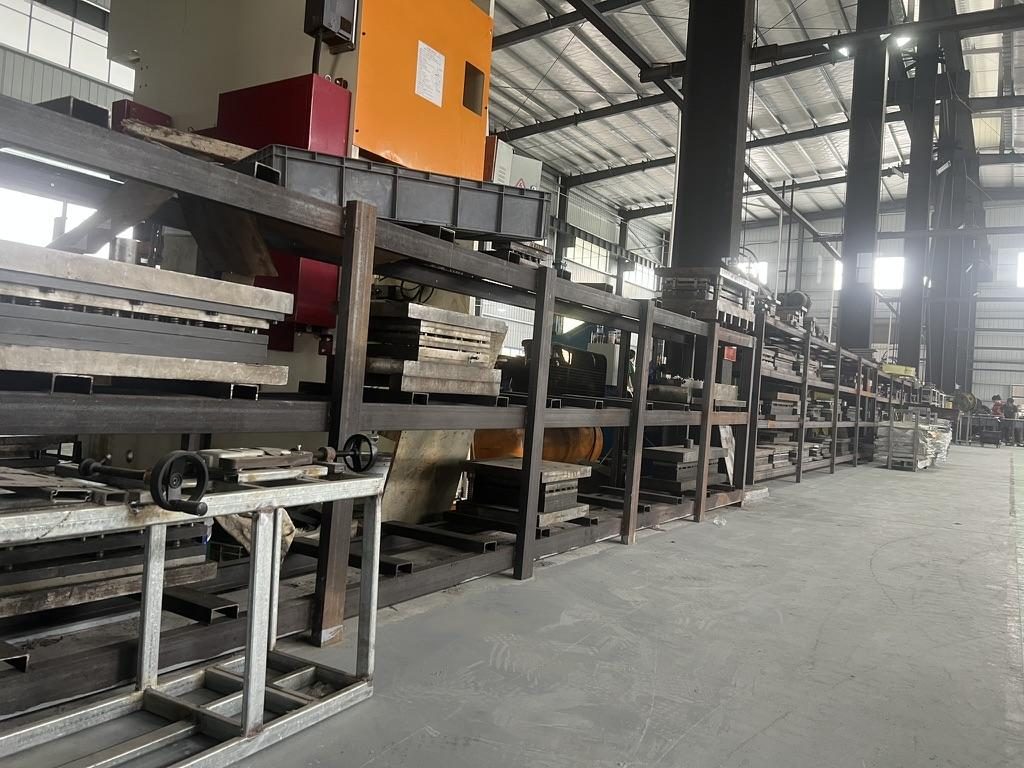 A row of customer-specific rail dies kept in the tooling store
-
Ask for a recent third‑party inspection or auditor contact (or permission to share anonymized audit summaries). If unavailable, plan for an independent pre‑shipment inspection.
- Verify certificate scans and request the ISO 9001:2015 scope statement showing slide/rail processing if the supplier claims ISO coverage. Use the certificate scan to confirm dates and scope rather than taking a single line in a brochure at face value.
- Request real sample- and production-history examples: order quantities, lead times, CAD iterations and whether the supplier supported a formal design-freeze process.
- Watch for sellers that only publish product catalogues or “compatible with X” claims without CAD/fit documentation — treat CAD/STEP availability as a technical gate.
Practical buying rhythm and procurement cautions
- Plan for seasonal lead-time swings (end-of-year rack demand can lengthen delivery windows).
- Negotiate DDP or US-warehouse options if time-to-market is critical, and confirm whether the supplier will accept landed-price responsibilities.
- Include an inspection/acceptance clause and a right-to-audit for the first production run. Require agreed acceptance criteria tied to production samples that represent the normal production process.
Compatibility, Technical Specifications, and Engineering Datasheets
Compatibility is a multi-level gate: matching a "19‑inch" label alone will not assure fit. Engineers need a complete technical intake packet and a systematic verification checklist before CAD approval.
Which standards and references to cite
- IEC 60297-3-100 and IEC 60297-3-105 (EIA‑310 family) provide the 482.6 mm (19 in) basic dimensional framework for racks and front panels — use them as a reference but do not assume the word “19‑inch” guarantees fit.
- If a buyer targets OCP ORv3 or other variants, expect different bay widths/OU vs RU increments and additional mounting constraints; clarify early whether adapters or conversion shelves are required.
Minimum datasheet and deliverable checklist to request
- Native CAD/STEP files for the rail assembly and sub‑components. If full CAD cannot be shared under NDA, request a mounting-area STEP that contains the rack/post and chassis interface region needed for verification.
- Detailed installation drawings: closed length, extended length, bracket (fit) range, pull‑out/lock‑out positions and any accessory positions. Important: closed length ≠ mounting depth ≠ fit range — ask for all three explicitly.
- Mounting-interface drawings: hole positions, slot geometry and any T‑pin (PEM) details (head diameter, shaft diameter, under‑head clearance and datum). J‑slot/keyhole dimensions must be derived from the pin; ask for both pin and slot drawings.
- Load ratings expressed explicitly and with test definition: per‑pair or per‑rail, static vs dynamic, extension state (full extension or retracted), fixture description and duration. For example, MetrixSlide’s heavy‑duty model has a nominal capacity of up to 180 kg per pair, and a formal test report at that load is not yet available — so always confirm the exact test method and whether the figure applies to your variant.
- Materials, surface finish and tolerances: steel grade(s) if available, thickness options, plating or powder-coating process, and recommended corrosion protection for the intended shipping/installation environment.
- Tolerance table and critical-dimension callouts (stamp hole positional tolerances, mating-feature tolerances). The supplier may quote internal precision targets (for example, a stated target for stamped hole fit), but request evidence (inspection reports) if fit is critical.
- Test reports and method descriptions: sag/deflection measurements under load (method and datum), life-cycle or sliding cycles (rig configuration), and pass/fail criteria.
Technical document request (one paragraph you can email) "Please provide native STEP/CATIA files for the rail assembly, detailed installation drawings (closed/extended/fit-range), a mounting‑area STEP for our chassis, material and finish specs, and load test reports specifying per‑pair vs per‑rail rating, test fixturing and duration. Also include T‑pin/PEM data and J‑slot geometry. If under NDA, we can execute a CDA and accept a mounting-area STEP."
Common document gaps from competing suppliers
- Catalog pages that list model names without CAD or test reports.
- Ambiguous load statements with no distinction between per‑rail vs per‑pair, static vs dynamic, or extension state.
- Missing T‑pin dimensions or keyhole drawings — these are essential whenever the chassis uses headed pins or J‑slots.
How to validate CAD against reality
- Verify datums and U-position alignment: compare the chassis datum to the rail front‑mount datum to ensure the device will land in the intended RU/U position. Small datum shifts (a few millimetres) can move the device into adjacent U-spaces.
- Run an interference/CAD check using the mounting-area STEP before ordering samples; then order a small physical sample set for full-fit and functional verification. Remember the working validation path: requirement → CAD/drawing → sample/physical fit → performance validation → design freeze. Passing CAD review is necessary but not sufficient.
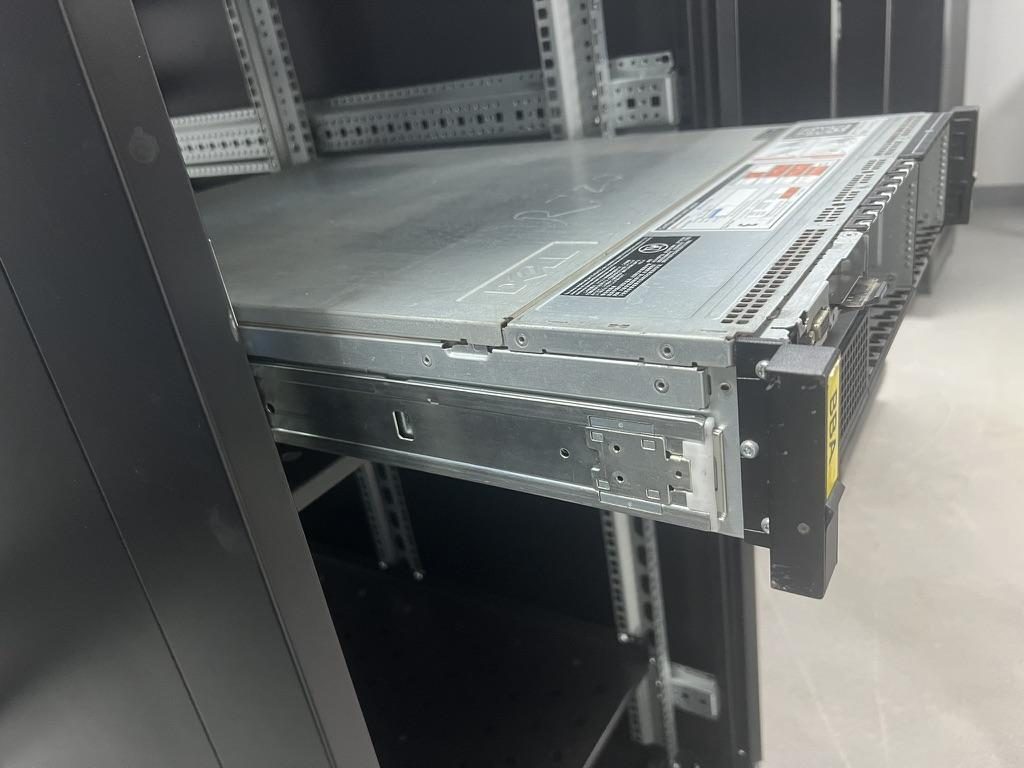
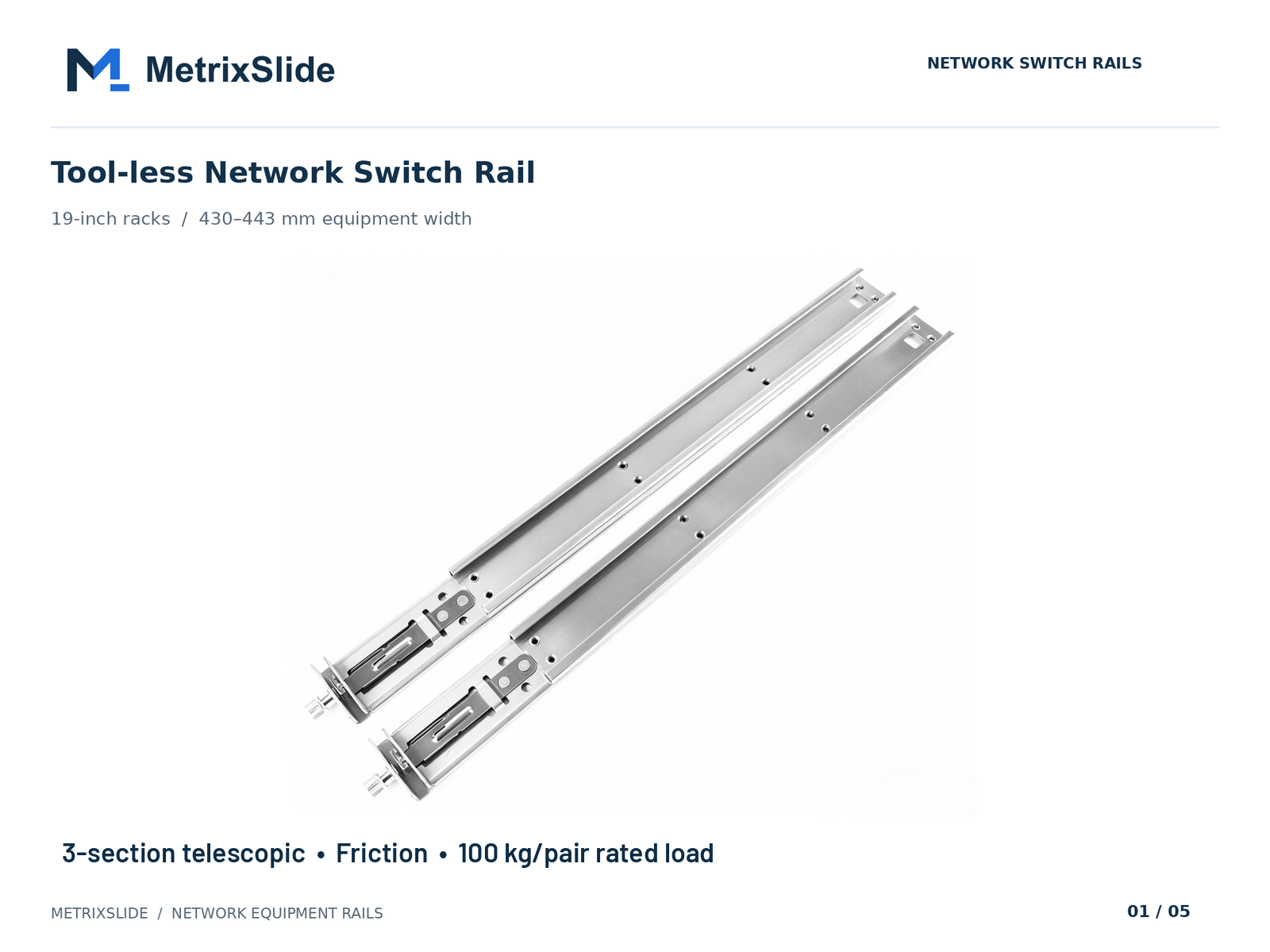 MS-FMR-SW-100 Tool-less Network Switch Rail — view product
Customization, Private-Labeling, Prototyping, and the OEM/ODM Process
Most projects follow a predictable engineering and commercial path. Knowing where changes are "bounded" (no heavy tooling) versus structural (tooling/NRE required) saves time and cost.
Typical OEM/ODM workflow (practical)
- NDA / technical confirmation — exchange mounting-area CAD and define hard gates (fit, load). Hard gates come first; preferences (ball-bearing vs friction, cosmetic finish) come after gates pass.
- Preliminary quote — specifies unit pricing bands, sample fees (if any), and whether bracket/hole-pattern changes are bounded.
- Engineering feasibility & DFM review — supplier classifies requested changes as bounded (flexible) vs structural. MetrixSlide engineering practice treats bracket position, hole-pattern, rail length and rail thickness as common flexible-customization inputs to evaluate; structural or 1:1 copy requests usually trigger tooling/NRE and longer lead times.
- CAD iterations and design reviews — expect 1–3 CAD cycles for bounded changes; structural redevelopment requires more engineering time and may add cost.
- Sample / prototype delivery — sample lead times in practice have been shown in multiple projects at roughly 15–20 days after confirmation for small engineering batches. Samples are validated for fit and function.
- Validation testing — execute agreed load, installation-sequence, sag/deflection and life-cycle tests and record fixtures, durations and pass/fail metrics. A common validation practice for heavy-duty slides includes prolonged static-load checks.
- Design freeze and production — release of final drawings, part numbers and production schedule; execute first-run inspection protocol.
Custom services and private‑label options
- Common customizations: length adjustments, bracket/hole-pattern modifications, additions of locks or positive‑release features, choice of sliding mechanism (ball‑bearing vs friction), finishes (electro‑plating, powder coat), silk‑screening or private‑label packaging.
- Branding and packaging: silk‑print, custom labels, and box inserts are standard private‑label add-ons; packaging specs should be agreed before pilot runs to assure compatibility with shipping and handling needs.
Cost & timeline drivers (what accelerates cost or tooling)
- Anything that changes die geometry or stamping forms (a new die) is a structural change and will attract NRE/tooling and longer lead times.
- Bracket-only changes, hole-pattern shifts within an existing blank profile, or length adjustments within an approved platform are often handled as bounded customizations — confirm this in writing in the quote.
- Prototype iteration count, sample finish options, and rush delivery accelerate costs.
Sample order contents (what to send)
- Mounting-area STEP preferred; rack post-to-post distance or bracket-range target; required load and desired lock/extension behavior; sample quantity (typical engineering evaluation: 5–20 pairs). Include preferred finish and marking instructions.
Added MetrixSlide engineering practice: a short OEM decision checklist
- Compatibility hard gates before preferences: (1) rack hole/type & post distance within candidate bracket range; (2) chassis mounting features (T-pin/keyhole/screw centre) align to rail front datum; (3) load requirement achievable by candidate architecture; (4) installation flow acceptable (stab‑in vs drop‑in). Only after these pass, consider sliding mechanism, finish and labelling.
Manufacturing Quality, Certifications, Testing and After‑Sales Support
Quality is verifiable through documented processes, test evidence and post‑shipment support commitments. U.S. buyers should demand transparency and contractual acceptance criteria.
Quality systems and certifications to verify
- Ask whether the supplier is ISO 9001:2015 certified and request the certificate scan plus the scope statement that explicitly lists slide/rail processing — do not accept a claim without the scope page. (If the supplier provides ISO documentation, verify issue/expiry dates and the named legal entity on the certificate.)
- Ask for RoHS/REACH compliance statements and any product declarations relevant to your market.
Meaningful tests and evidence to request
- Static load test reports stating the basis (per‑pair vs per‑rail), extension state and duration. In MetrixSlide’s factory static‑load test a rail pair is held under load at full extension for 24 hours, and the MS‑FMR‑2U‑100 held 100 kg in that test; request the exact fixture description and acceptance criteria.
- Sag/deflection measurements at full extension with the measurement datum and method documented.
- Life or cycle testing for bearings/contacts with the rig configuration and cycles-to-failure when available.
- Material inspection records and batch traceability for critical stamped parts; confirm whether die IDs or batch numbers are recorded for traceability. Note: internal stated stamping precision goals exist but require verification by inspection reports before relying on them (request measurement reports if hole-fit is critical).
After‑sales support and contract terms to negotiate
- Warranty: specify duration and coverage (defects in materials or workmanship), and whether replacement parts or repair labor are included.
- Spare parts and wear items: ask for lead times for spares (inner rails, bearings) and minimum order quantities.
- Inspection options: agree on a pre‑shipment inspection (PSI) plan or third‑party inspection acceptance criteria (sampling level, defect tolerances). Include a right-to-audit clause for the first production lot.
- Escalation and remote support: define engineering query channels and response SLAs.
Contractual acceptance examples to include
- Acceptance tied to production samples that pass agreed fit and load tests with documented fixtures and measurement datums.
- Remedy clauses for failing production lots (rework/replacement) and the agreed inspection levels.
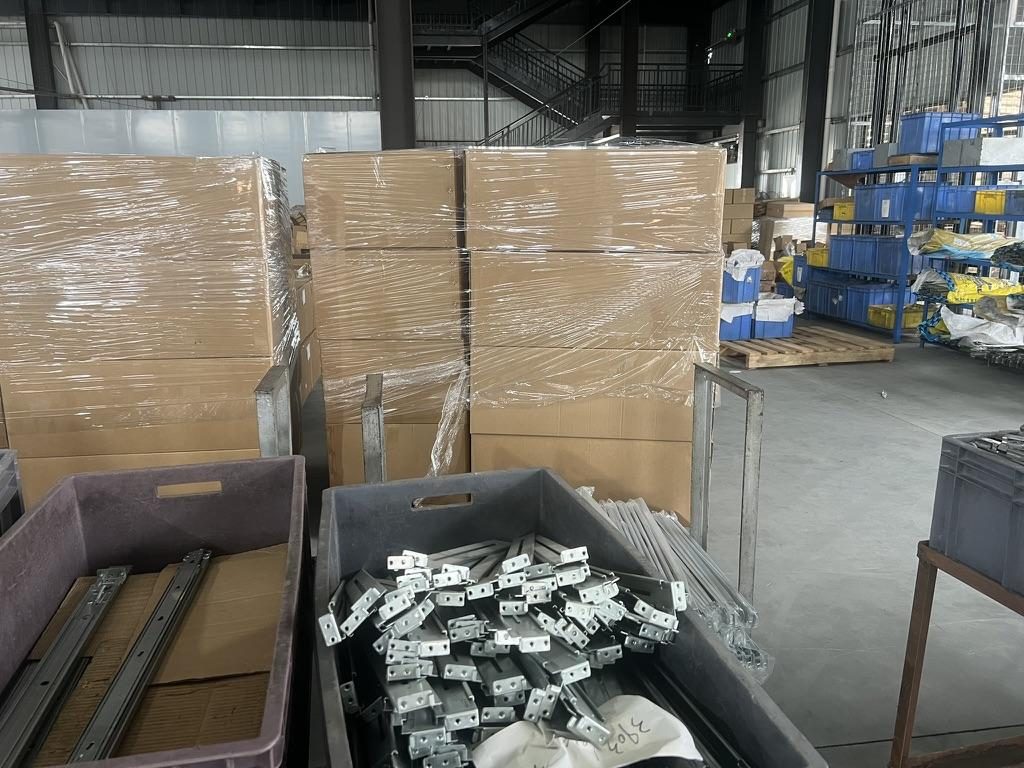 Finished server rails being packed for shipment
Logistics, Packaging, Samples, and International Shipping for U.S. Buyers
Plan logistics with the same rigor as the engineering path: inadequate packaging or unclear incoterms cause damage, delays, and unexpected landed costs.
Packaging and sample handling guidance
-
Ask for packing photos and packaging specs: inner protection, orientation restraints, palletization and carton sizes. Verify single‑pair vs multi‑pair per box configurations to calculate handling and carton counts.
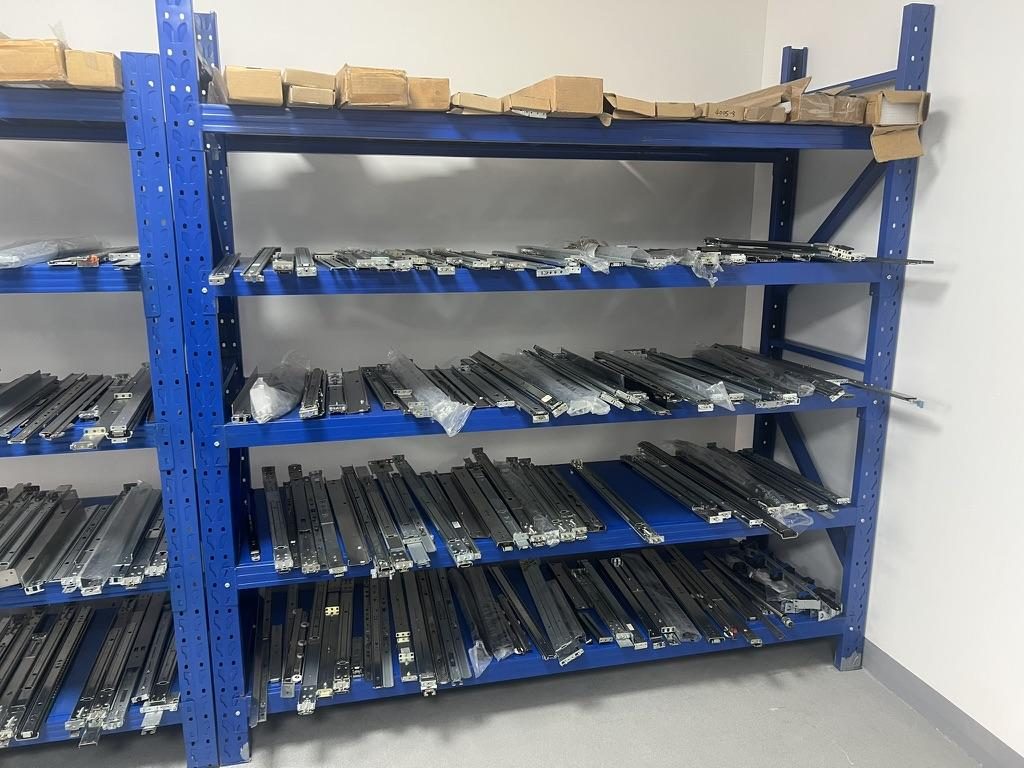
 Rail kits packed in cartons before palletising
-
Protective materials: rails should be secured to prevent telescoping and protected against surface damage (edge guards, foam pads). Specify rust inhibitors or desiccants for sea shipments if surface protection is required.
Sample vs production shipping choices
- For urgent validation, use courier for samples; for heavier prototype batches, LCL or air‑freight is appropriate. Confirm the supplier’s sample shipping policy and any sample fees. MetrixSlide sample practice in recent compatibility-first projects has shown sample lead times around 15–20 days after confirmation.
- For production, communicate preferred Incoterm (EXW, FOB, DDP). DDP provides the simplest landed experience for U.S. buyers but is costlier; EXW gives control over freight and customs.
Documentation and customs
- Required documents: commercial invoice, packing list, bill of lading / airway bill, and origin documentation (certificate of origin if claiming trade preference). Confirm HS codes and whether any duty preferences like USMCA apply depending on origin and product classification.
- Mark any compliance markings required for U.S. distribution (RoHS/REACH statements, part labelling).
Practical checklist before release to ship
- Final inspection report and photos for the lot.
- Packaging confirmation and palletization plan.
- Agreed carrier and transit insurance option.
- Clear instructions for US clearance agent and consignee contact.
Conversion / CTA
RFQ fields to include on your buyer email or procurement portal:
- Include CAD/STEP, load rating, sample quantity and explicit test acceptance criteria in the request.
- Standard RFQ fields: required quantity, target delivery date, chassis drawing or mounting‑area STEP, rack post distance/bracket range, preferred finish, required load and extension/lock behavior, acceptance test items.
- Sample policy selection: courier vs sea sample, sample count and required inspection/test protocol.
Suggested RFQ response SLA: request that suppliers confirm receipt within 48–72 hours and provide an initial feasibility reply (CAD feasibility, bounded vs structural changes) within 5–7 business days. Ask suppliers to include factory photos or virtual tour links and an option for third‑party inspection.
FAQ
Q: What criteria should I use to shortlist OEM server rail manufacturers for U.S. procurement?
A: Prioritize verifiable capabilities: ask for ISO 9001:2015 scope, factory photos or a virtual tour, recent production/sample lead times, sample policy, and evidence of load testing or fielded projects. Use the supplier comparison table fields (capacity, MOQ, payment terms, test reports) and require references or anonymized case studies.
Q: How can I confirm a server rail is compatible with specific rack and server models (EIA‑310, Dell, HPE, Lenovo)?
A: Don’t rely on the “19‑inch” label alone — request mounting‑area CAD/STEP, the rail’s closed/extended/fit‑range dimensions, and explicit hole/slot geometry for the rack posts and chassis T‑pins. Perform a CAD interference check, then validate with physical samples to confirm U‑position and front‑mount alignment.
Q: What technical documents should suppliers provide before purchase (CAD/STEP, load ratings, test reports)?
A: At minimum request native CAD/STEP files, installation drawings (closed/extended/fit range), T‑pin/J‑slot drawings, material and finish specs, and load test reports showing per‑pair vs per‑rail ratings and test conditions. Also ask for tolerance tables and any life‑cycle or sag/deflection test data.
Q: What customization and private‑label services do OEM manufacturers typically offer, and what are typical tooling and prototyping timelines?
A: Bounded customizations often include bracket position, hole pattern, rail length and thickness and can usually be handled without new tooling; structural changes that require new dies or forms will attract NRE/tooling. Prototype/sample lead times for engineering batches are commonly in the multi‑week range (MetrixSlide samples commonly ship in ~15–20 days after confirmation).
Q: Which certifications and factory quality evidence meaningfully reduce supplier risk?
A: ISO 9001:2015 with a scope that covers slide/rail processing, RoHS/REACH declarations, and documented load/sag test reports are the most actionable certifications. Supplement certificates with recent factory photos, evidence of batch traceability and a willingness to accept third‑party inspection for the first production lot.
Talk to a MetrixSlide engineer
Ready to move from research to a real quote? Send us a chassis drawing or model (STEP or DWG), the rack post-to-post distance and hole type, the expected load and your planned quantities. Within 24 hours you get a rail matching proposal from an engineer, followed by 2D/3D drawings for review and sample pairs (typically 15–20 days after drawing approval) for physical validation before the full order.
Bracket position, hole pattern, rail length and thickness adjustments on our existing platforms usually carry no tooling fee; structural redesigns are quoted separately with dies made in-house.